

Noctua industrialPPC (Protected Performance Cooling) series is actually one of the two new fan series recently added to the company portfolio entirely made for industrial heavy duty application that require enhanced cooling performance and advanced ingress protection. The fans included in the IndustrialPPC series are based on the very well known F and A series and are made to provide superior airflow and static pressure capacity while keeping noise levels and power consumption moderate in comparison to high-speed fans, which is done thanks to the outstanding aerodynamic efficiency of the NF-F12 and NF-A14 designs and the use of a novel three-phase motor.
Noctua industrialPPC offers:
- NF-F12 industrialPPC-2000 – a 120 x 25mm model working at 2000 RPM, providing airflow level of 121,8 m³/h, static level pressure of 3,94 mm H2O, at noise level of 29,7 dB(A). The fan offers ingress Protection – IP52 and is 3-pin powered and regulated.
- NF-F12 industrialPPC-2000 PWM – a 120 x 25mm model working at 2000 RPM, providing airflow level of 121,8 m³/h, static level pressure of 3,94 mm H2O, at noise level of 29,7 dB(A). The fan offers ingress Protection – IP52 and is 4-pin PWM powered and regulated.
- NF-F12 industrialPPC-2000 IP67 PWM – a 120 x 25mm model working at 2000 RPM, providing airflow level of 121,8 m³/h, static level pressure of 3,94 mm H2O, at noise level of 29,7 dB(A). The fan offers ingress Protection – IP67 and is 4-pin PWM powered and regulated.
- NF-F12 industrialPPC-3000 PWM – a 120 x 25mm model working at 3000 RPM, providing airflow level of 186,7 m³/h, static level pressure of 7.63 mm H2O, at noise level of 43.5 dB(A). The fan offers ingress Protection – IP52 and is 4-pin PWM powered and regulated.
- NF-A14 industrialPPC-2000 – 140 x 25mm model working at 2000 RPM, providing airflow level of 182,5 m³/h, static level pressure of 4.18 mm H2O, at noise level of 31.5 dB(A). The fan offers ingress Protection – IP52 and is 3-pin powered and regulated.
- NF-A14 industrialPPC-2000 PWM – 140 x 25mm model working at 2000 RPM, providing airflow level of 182,5 m³/h, static level pressure of 4.18 mm H2O, at noise level of 31.5 dB(A). The fan offers ingress Protection – IP52 and is 4-pin PWM powered and regulated.
- NF-A14 industrialPPC-2000 IP67 PWM – 140 x 25mm model working at 2000 RPM, providing airflow level of 182,5 m³/h, static level pressure of 4.18 mm H2O, at noise level of 31.5 dB(A). The fan offers ingress Protection – IP67 and is 4-pin PWM powered and regulated.
- NF-A14 industrialPPC-3000 PWM – 140 x 25mm model working at 3000 RPM, providing airflow level of 269.3 m³/h, static level pressure of 10.52 mm H2O, at noise level of 41.3 dB(A). The fan offers ingress Protection – IP52 and is 4-pin PWM powered and regulated.
For this test and review I received Noctua NF-F12 industrialPPC-2000 and Noctua NF-F12 industrialPPC-2000 PWM, which to be honest I am pretty eager to test and review.
So let’s do the job…
Both of the fans arrived to me for doing a test and review in completely newly designed boxes, very stylish and at the same time pretty simple looking, entirely made of carton, painted in black and brown colour scheme. On the front side of the boxes there are just the company logo and the series name with the model name included. Of course, the full technical specification regarding the products is located on the back of the packages on a white label.
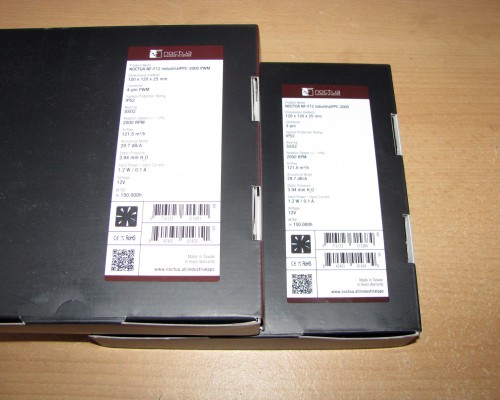
The boxes look pretty nice and stylish to be honest but the most interesting thing is located inside of them.
And this is the view, which I got after I opened the black/brown packages.
| Noctua NF-F12 industrialPPC-2000 | Noctua NF-F12 industrialPPC-2000 PWM |
 |
 |
Both of the fans look absolutely identical and were placed in the middle of the boxes inside of cartoon beds, which are made to provide good protection for the fans and at the same time hide the additional accessories, about which I will talk a bit later.
Now let’s check out the fan structure.
Noctua NF-F12 industrialPPC-2000 and industrialPPC-2000 PWM STRUCTURE
Before I do that I want to say that both fans are actually the same model based on the very well known model Noctua NF-F12, announced a few years ago with some major visual and performance improvements. And the only difference between Noctua NF-F12 industrialPPC-2000 and Noctua NF-F12 industrialPPC-2000 PWM is the 4-pin PWM regulation.

Both of the fans offer the standard NF-F12 structure and design with some improvements featuring:
A square 120 x 25mm, done entirely from fibre-glass reinforced polyamide and painted in black matte frame and made to withstand temperatures of up to 140°C and make the fans even more rigid and break-proof than the original Noctua fans. The frames themselves feauture the very well known AAO Frame (Advanced Acoustic Optimisation) technology, which offers integrated anti-vibration pads as well as Noctua’s proprietary Stepped Inlet Design and Inner Surface Microstructures, both of which additionally improve the fan’s performance and the noise efficiency. Apart from that, the frames are made to provide the Focused Flow™ technology, featuring eleven stator guide vanes, entirely made to straighten, channel and focus the airflow and designed for pressure demanding applications such as heatsinks and radiators with smaller fin gaps. The stator guide vanes themselves feature Varying Angular Distance and Vortex-Control Notches, both made to spread the noise emission over a broader frequency spectrum and thus make the fan’s sound pattern more convenient to the customers.
| Noctua NF-F12 industrialPPC-2000 | Noctua NF-F12 industrialPPC-2000 PWM |
 |
 |
Apart from the frames, both of the fans offer Heptaperf™ Propellers, which are especially designed for the new Focused Flow frames and to work in the best way with the eleven stator guide vanes. The new propellers, entirely made of fibre-glass reinforced polyamidehas, feature 7 very wide and at the same time not very sharply angled blades and are carefully optimized to achieve a perfect balance between performance and noise level.
The connection between the frames and the propellers is done by the traditional Noctua’s SSO2 Bearing and offering the new three-phase motor, which features three-phase design with 6 slots, is made to provide smoother transitions between the slots and thus allows for even higher running smoothness, further reduced vibrations and much higher energy efficiency. With the new three-phase motor, the fans are made to provide 10% lower power consumption in comparison to other models from other brands at same revolutions per minute.

The power and the regulation of the fans is done, by a very long, entirely sleeved in black, three pin cable and connector for Noctua NF-F12 industrialPPC-2000 and four pin PWM for Noctua NF-F12 industrialPPC-2000 PWM. With this cable length the fans can be a very good choice for CPU cooling or boosting the airflow inside the case.
Noctua NF-F12 industrialPPC-2000 and industrialPPC-2000 PWM ADDITIONAL ACCESSORIES

Both fans arrived with absolutely identical additional accessories packs, which feature:
- One set of four installation screws to attach the fans to a case fan slot
- 8 rubber pads, which should be attached to the corners of the fans for reducing the fan vibrations, if there are any.
Well, I was expecting a bit more of additional accessories, but seems Noctua decided to provide only the basic accessories for industrial purposes.
I believe it is time to install the two fans on my test stand and check out how they will perform.
Noctua NF-F12 industrialPPC-2000 and industrialPPC-2000 PWM TESTS
The tests will be conducted in my standard way. I will install the fans and test them at 5V/7V/9V/12V and my goal will be to check the performance of the products in real conditions. They will be tested under close-to-perfect conditions, not taking into account any external factors. The results achieved during the test can in no way be the same if the models are mounted on a cooler or on the case fan hole of any modern computer case. I will measure the amount of air going through the fans for one hour and their speed. For this I use a fan controller, a voltage meter, an anemometer and a stand made specifically for this purpose.
And this is what the fans look like installed on my test stand:

The test results are shown in the following charts:
Airflow through the fans at 5V, 7V, 9V, 12V

Propeller rpm during the tests at 5V, 7V, 9V, 12V.

The anemometer showed the following air speed passing through the propellers:

After mounting the fans onto the stand, and leaving them to rotate for about 60 minutes at maximum speed, it was time for the tests to begin.
As with my other tests, again I started with a gradual increase of the voltage through the Lamptron FCT starting at 0V and both of the fans made at least one stable revolution at about 8.5V. To do my tests I had to decrease the operation voltage back to 5V and check their performance.
Test at 5V:
At the first test conducted at exactly 5V, which is much below the fans’ starting voltage, Noctua NF-F12 industrialPPC-2000 and Noctua NF-F12 industrialPPC-2000 PWM were rotating at absolutely identical 900 revolutions per minute providing airflow level of 51.84 cubic metres per hour. Both of the fans were absolutely silent.
Test at 7V:
At the second test conducted at exactly 7V, which was still below the fans’ starting voltage, Noctua NF-F12 industrialPPC-2000 was rotating at 1230 revolutions per minute providing airflow level of 74.88 cubic metres per hour, while Noctua NF-F12 industrialPPC-2000 PWM was providing 73.44 cubic metres per hour, again at 1230 revolutions per minute. At this test both of the fans remained silent.
Test at 9V:
At the third test conducted at 9V, which was a bit higher than the fans’ starting voltage, Noctua NF-F12 industrialPPC-2000 was providing airflow level of 97.92 cubic metres per hour, while rotating at 1620 revolutions per minute. At this test Noctua NF-F12 industrialPPC-2000 PWM was providing 96.48 cubic metres per hour, while rotating at 1590 revolutions per minute. At this test both of the fans started generating a tiny noise coming out of the air passing through the propellers and the vanes.
Test at 12V:
At the last test conducted at 12V, both fans reached their maximum performance, which for Noctua NF-F12 industrialPPC-2000 was airflow level of 132 cubic metres per hour at 2100 revolutions per minute, while for Noctua NF-F12 industrialPPC-2000 PWM it was 131.04 cubic metres per hour, while rotating again at 2100 revolutions per minute. Both fans increased the noise and became really noisy, which for these revolutions per minute was pretty much expected.
And here I want to share something which I like a lot. When the current for both of the fans is cut off their propellers stop rotating at absolutely the same time, which made me think that both of the fans offer absolutely identically balanced motors with amazing quality.
Noctua NF-F12 industrialPPC-2000 and industrialPPC-2000 PWM CONCLUSIONS
1. Noctua NF-F12 industrialPPC-2000 and industrialPPC-2000 PWM Performance:
After I spent a couple of hours reviewing and later testing the fans, I should say that I am pretty impressed with the overall cooling capabilities of the new Noctua NF-F12 industrialPPC 120mm models.
Both of the fans are actually one pretty serious set of technologies entirely made to deliver the best possible cooling performance, combined with very high static level pressure, while operating at very low noise level in comparison to other fans, from other brands working at same revolutions per minute. Apart from that the structure of the fans features very robust frames and propellers made of fibre-glass reinforced polyamide and very reliable and perfectly balanced motors delivering long lasting life up to 150 000 hours and IP52 dust and limited water proof protection.
All of the technologies together provide a wide range of compatibility, which make both of the fans applicable for industrial purposes working in very high duty environments and at the same time for regular or enthusiastic customers who demand high airflow and high static level pressure to keep their machines working cool and stable for a long time.
Both of the fans are a really good choice to be used as CPU cooler fans installed on a heat sink or water cooling radiator compatible with 120mm fans to keep every modern processor running cool and stable at default, overclocked or even extremely overclocked frequencies. Apart from that, with the very long cable attached to the motors, both of the fans are one really good choice for boosting the overall airflow inside any case, which features a 120mm case fan slot.
2. Noctua NF-F12 industrialPPC-2000 and industrialPPC-2000 PWM Appearance:
As you may know, I am not really a fan of the typical Noctua’s colour scheme and according to my opinion it is not really compatible with the colour scheme of the modern cases, but the new black/brown colour scheme is something brand new and much more appropriate. All of the models in the industrialPPC feature the black/brown colour scheme, which will be much more neutral and will definitely fit in every modern case with entirely black interior. Good job, Noctua, on this one!
I think Noctua NF-F12 industrialPPC-2000 and industrialPPC-2000 PWM deserve the following reward:

Noctua NF-F12 industrialPPC-2000 and industrialPPC-2000 PWM have been added to the 120mm fans catalogue.
Official price (MSRP): Noctua NF-F12 industrialPPC-2000: 24.90 Euro
Official price (MSRP): Noctua NF-F12 industrialPPC-2000 PWM: 24.90 Euro
Warranty: 72 months
I thank Noctua for the test sample.

How much current/power does it draw from power rail, at different voltages? Withoud this information this review is totally useless!
Hello Mr. Undisclosed,
This is actually pretty good point. I would add some bits even though your undisclosed message tells a lot about the future of this conversation.
All models part of the NF-F12 industrialPPC-2000 are rated with MAXIMUM input power of 1.2W and MAXIMUM input current of 0.1A at full speed.
Average motherboard is capable to provide 1A for the fan headers. Still every manufacturer provide different capabilities and there is no proven standard. Which means you are capable to connect up to lets 9 fans in order to keep on the safe side. And those fans are going to work at full speed with full noise level all the time just to reach that 1A.
Average middle tower case is capable to host for up to 6 fans, while average big tower case is capable to hold up to 10 maybe 12 fans.
Theoretically if someone decide to install 10 fans in a big tower case he would definitely need additional fan controller just because the length of the cables of the fans are not long enough to reach the Y-adapters connected to the fan headers on the motherboard. If additional fan contoller is used than it would be powered from the PSU directly.
Average 550W power supply can deliver up to 45A of current on the 12V line which is far more than enough.
Still if you think to use those fans in industrial environment I believe you can afford to obtain a decent power supply which will deliver much more than 1A by default.
For that reason I would like to ask is it really that important how many mA the fan will consume when working at 5V, 7V and 9V because at 12V, aka full speed with this rating of 0.1A it is basically nothing. Still if you need to connect 5 fans to the CPU fan header in parallel you should definitely consult with the manufacturer of your motherboard exactly how much current and power this header can deliver.
I doubt anybody is connecting fans to 1 header in series chain. There is no sense at all.
Best Regards,
A nice review of the much expected not vomit brown Noctua fans! However, I have some constructive feedback.
Dobri, the graph with two similar colours for the two different fans is not readable. I get that they are practically the same fan but it is not clear enough as it is now. Something like a different colour of the shade and same base colour would make more sense to me. Moreover, I wish there were tests with PWM control or at least the spectrum of the % of RPM the fans allow to be controlled in. After all, this is a major selling point for the PWM fans as 2000+ RPM is more than loud therefore every consumer will want to lower their RPM for 24/7 usage.
Otherwise, great review again.
Can’t wait to see review of the A14 IndustrialPPC fans. 🙂
Thank you for the feedback.
I was expecting such thing to happen and I will fix the charts asap I have some free time.
Thanks again.
Once again – great job doing the review. Coolers look good, even that I don’t mind the old brown-white color scheme. A big warranity is always welcome, but so few accessories for this pice seem little greedy.
Their arguement for the sparse accessories is that those are server/commercial fans therefore accessories are unnecessary as the fans are probably going to be used at full RPM in a server. That is the reason why the RPM starts at 2000 and the only thing they give to end users is PWM control to try and tame those beasts. Especially the 140mm ones at 3000RPM are very high performance fans.