
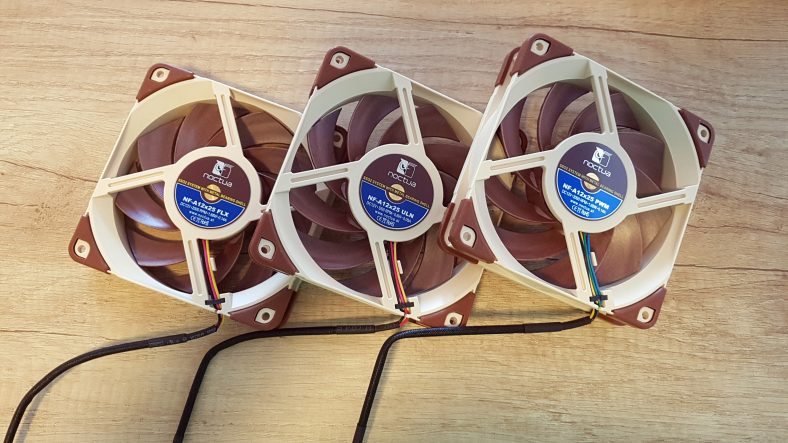
Noctua is a company which for the past several months has released a wide range of brand new fans with various shapes, performance capabilities and sizes. Fans which have been constantly improved to provide more and better and that includes the latest 120mm models aka NF-A12x25 FLX , NF-A12x25 ULN and NF-A12x25 PWM. Fans, which include even more new and very interesting features delivered by combining a wide range of pretty sophisticated technologies.
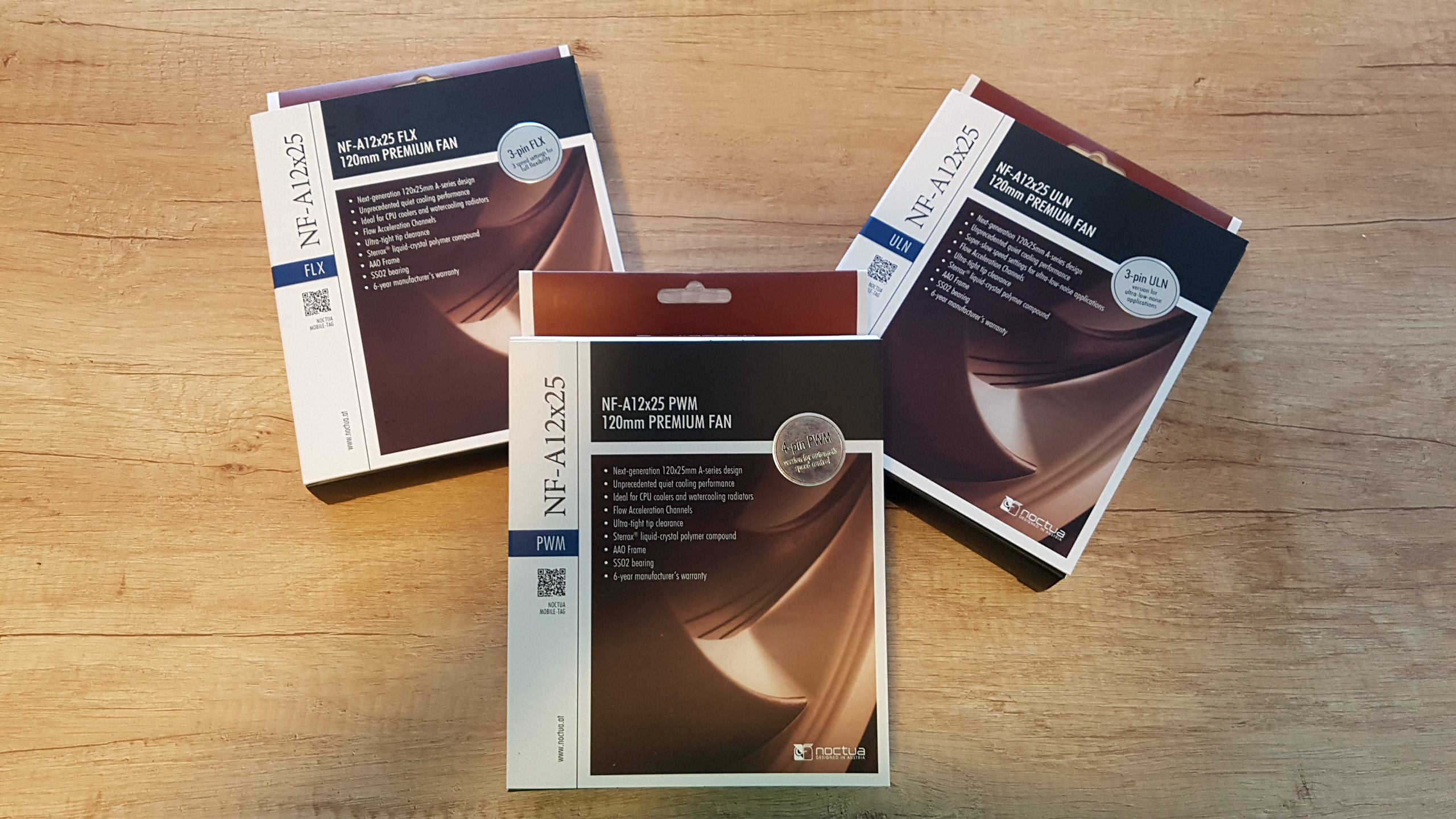
For this test and review I’ve received all three A12x25mm fans, which arrived to me placed inside the typical for the A series carton box painted in the white/black/brown colour scheme featuring a colorful front flap covering a see through cut, through which we can see a glimpse of the metal rotors holding the propellers. On the other hand the flap cover on the back side of the package is hiding the additional information for the technologies used so these fans can be created.
| NF-A12x25 FLX front flap | NF-A12x25 ULN front flap | NF-A12x25 PWM front flap |
 |
 |
 |
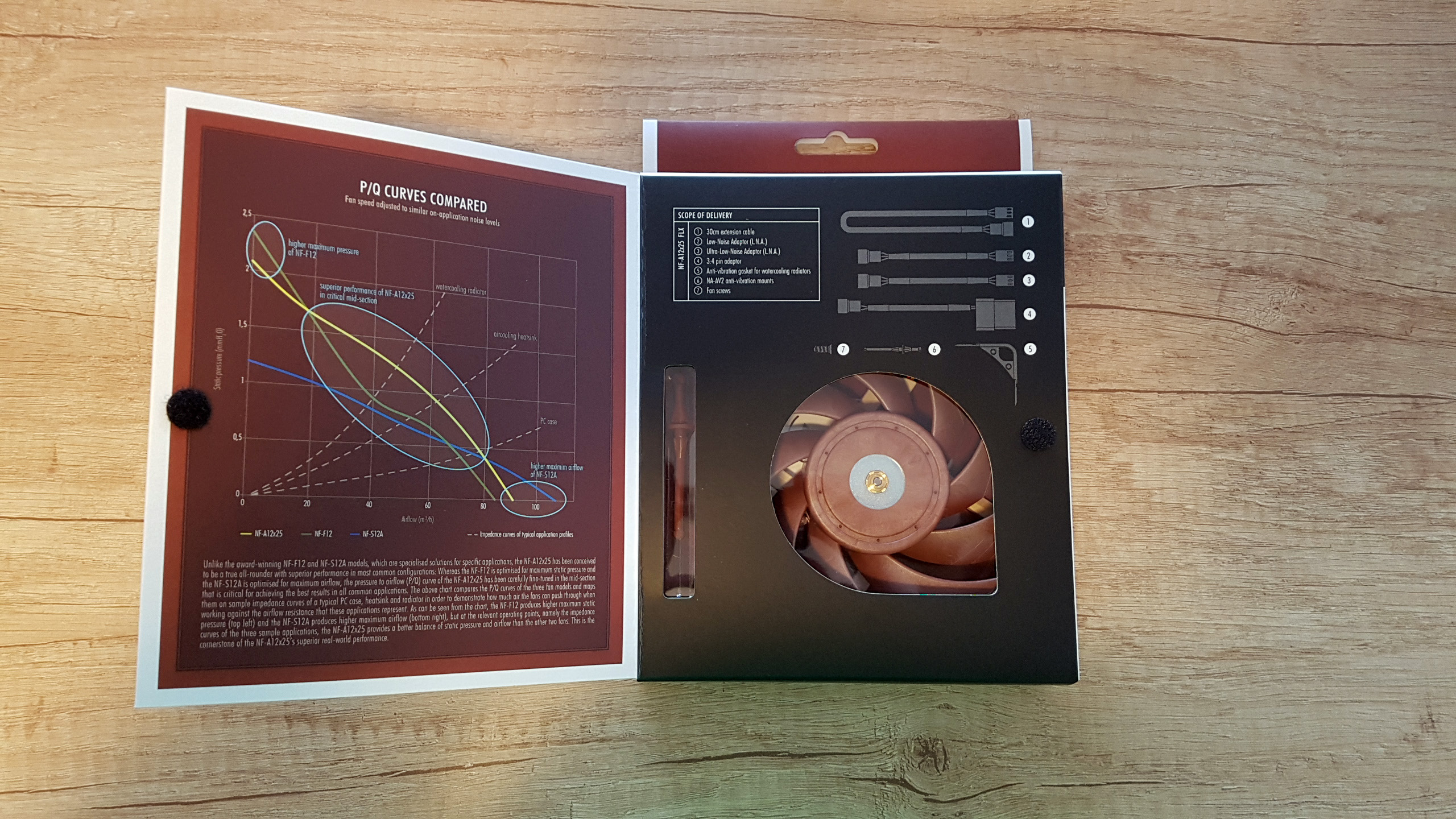
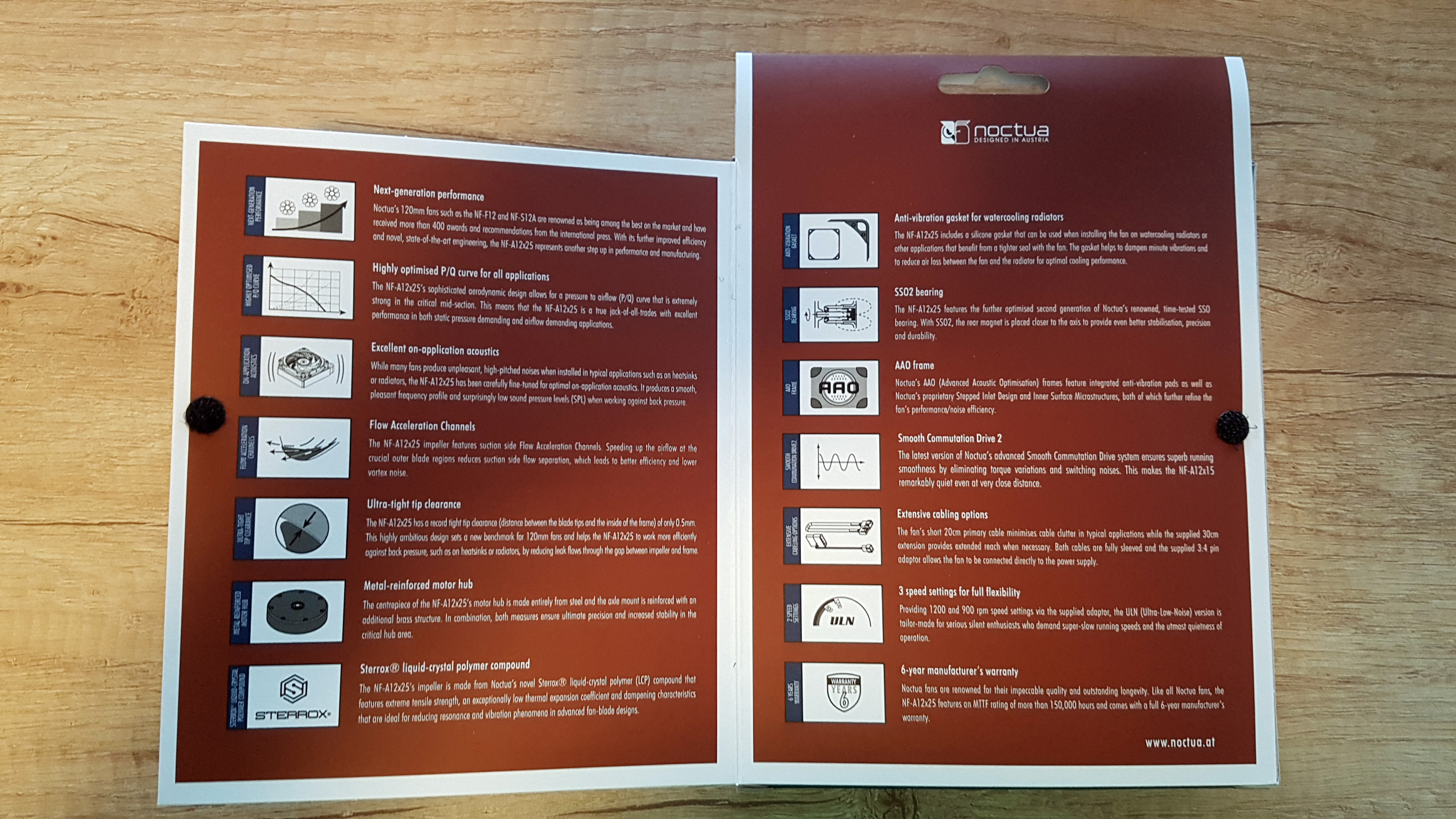
By lifting the front flaps I reached a lot of additional information and explanations regarding the additional accessories and the performance features of the products. Since these are Noctua products the information was definitely very extensive. In addition, there is a very detailed operational schematic demonstrating the performance capabilities of every single fan.
| NF-A12x25 FLX back flap | NF-A12x25 ULN back flap | NF-A12x25 PWM back flap |
 |
 |
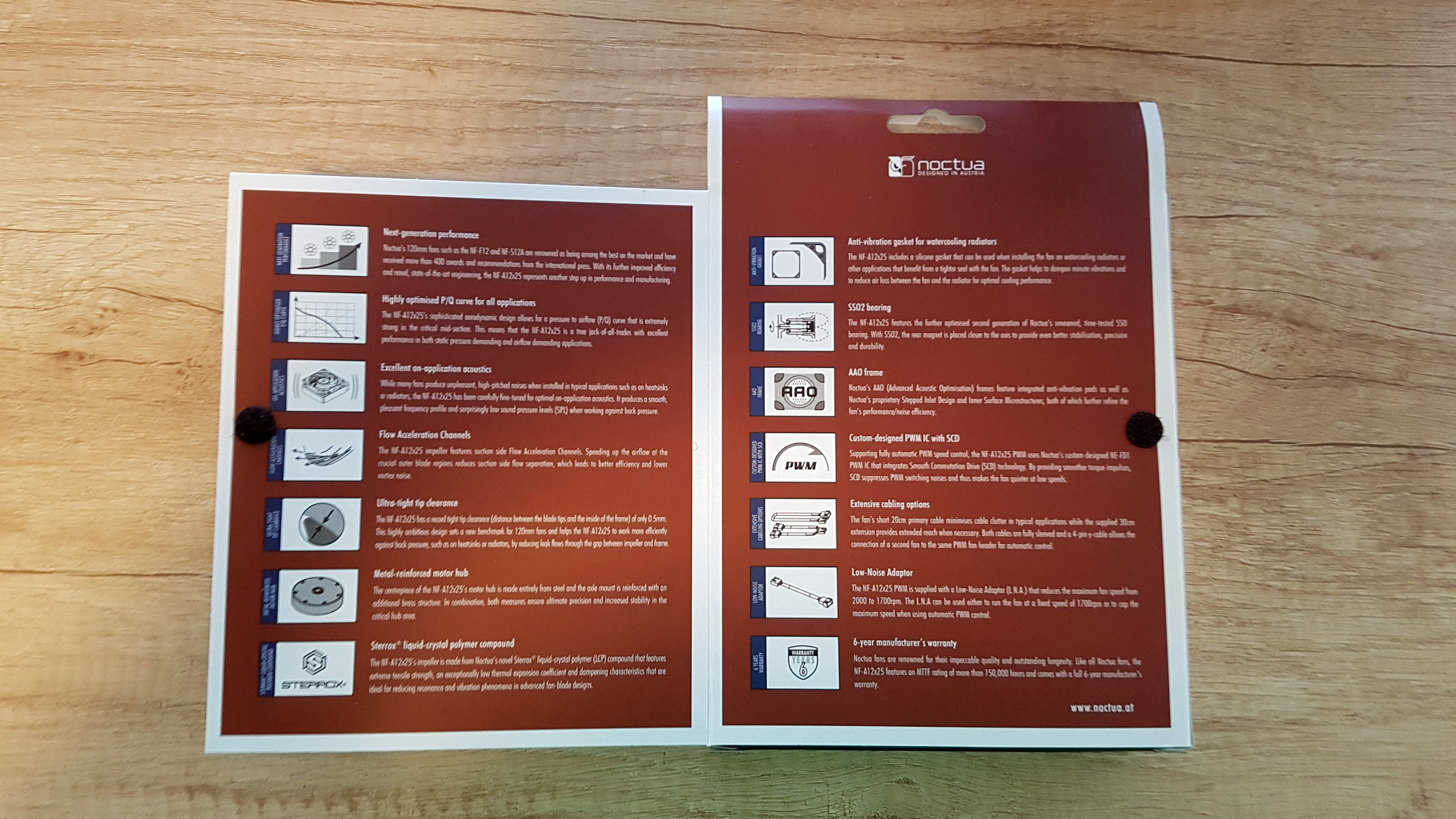 |
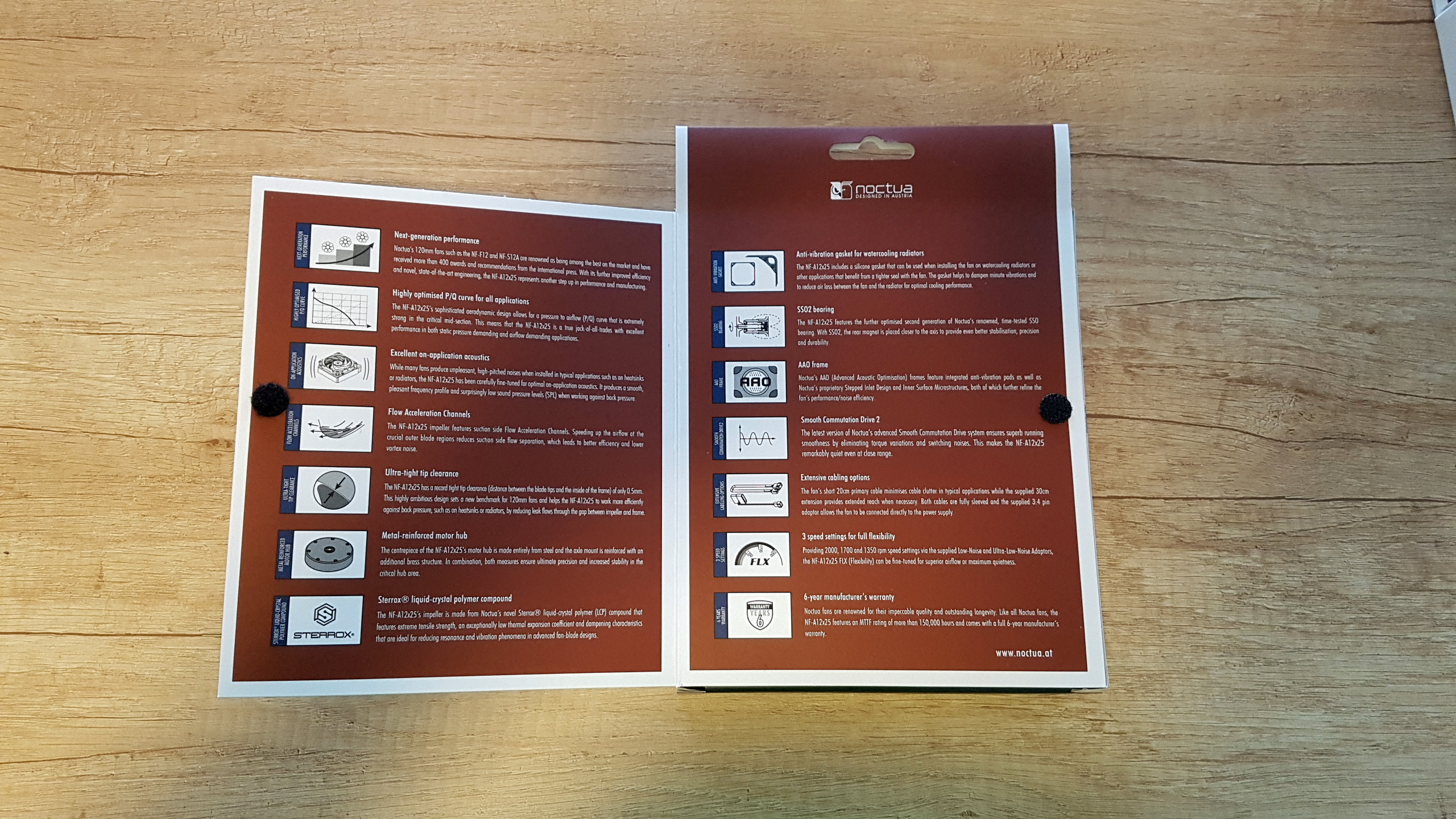
Of course, by lifting the back flaps of the boxes I reached to all of the information regarding the technologies used so these products can be created, while the full technical specification is listed on the back of the boxes in several languages. Overall the technologies list is very long and there are many new interesting things related with these models.
Personally, I really enjoyed the packages but let’s put them aside and proceed with checking the fan structures one by one.
Noctua NF-A12x25 FLX , ULN and PWM STRUCTURE
As soon as I had the chance to touch the fans for the first time, I saw that they are in the typical Noctua signiture, which features a very solid and reliable frame with detachable rubber shock absorbing pads in each corner combined with very stable, really high-tech and seriously improved looking propeller. The three samples which I got are identical in matter of structure and the only differences between them are their actual cooling performance, powering method and additional accessories.
So, let’s check the structure and features of the fans, which according to the manufacturer are optimized for the best possible balance between airflow and noise levels.
| NF-A12x25 FLX | NF-A12x25 ULN | NF-A12x25 PWM |
 |
 |
 |
All three fans are designed with identical square 120 x 120 mm and entirely in light pink 25mm thick frames with 105 x 105mm screw hole pattern supplied with integrated Anti-Vibration Pads made from extra-soft silicone designed to minimize the transmission of the vibrations while maintaining full compatibility with all standard mounting systems and fan clips used on heat sinks.
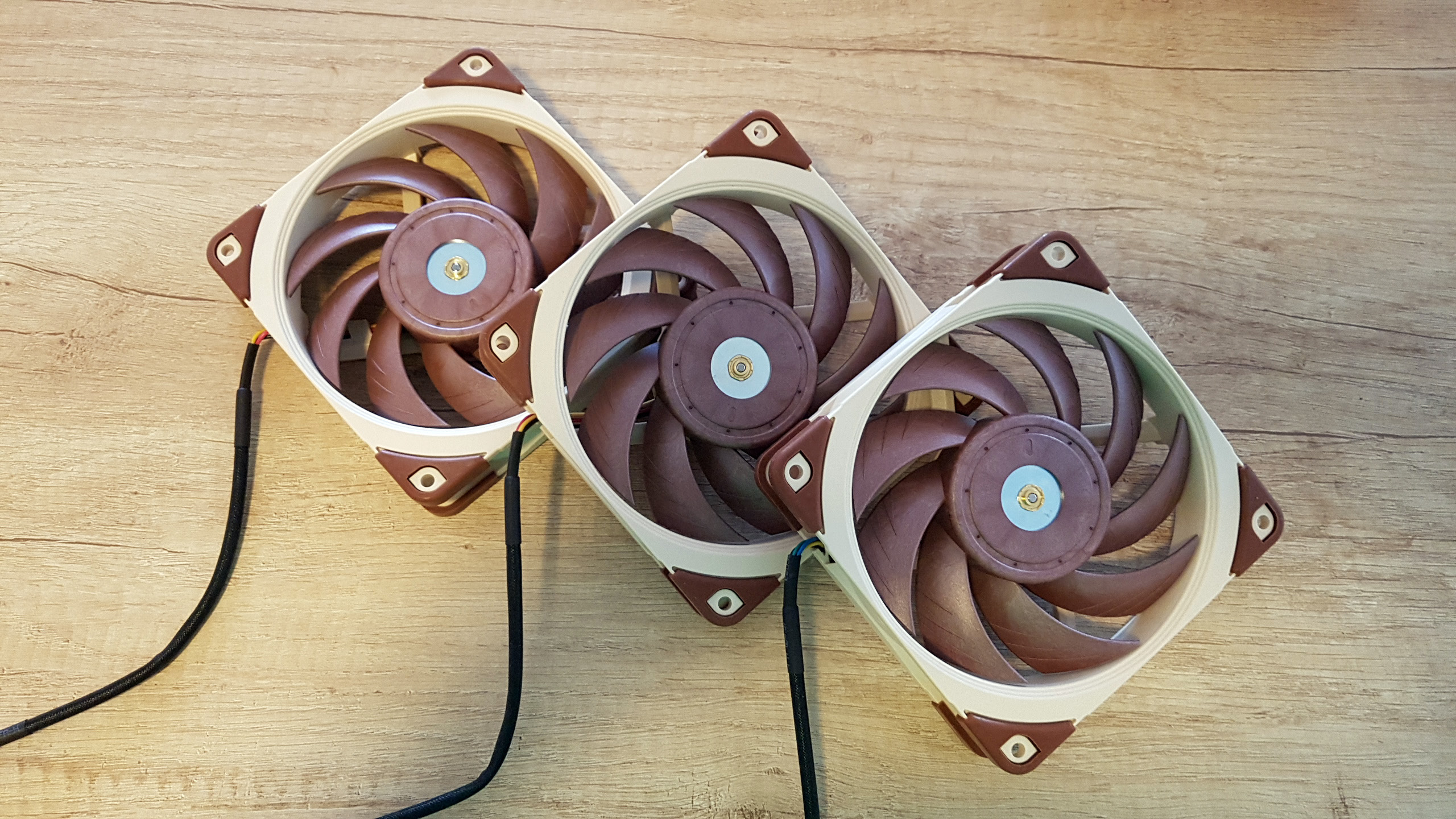
And since this is a product part of Noctua’s portfolio, all of the frames feature the very well known AAO Frame technology as well the Noctua’s proprietary Stepped Inlet Design and Inner Surface Microstructures, both of which designed and added to improve the fan’s performance and the noise efficiency. In addition to these products, Noctua added Anti-vibration silicon gasket that can be used when installing the fans on water cooling radiators or other applications that benefit from a tighter seal with the fan. The gasket helps to damp minute vibrations and to reduce air loss between the fans and the radiators for optimal cooling performance.
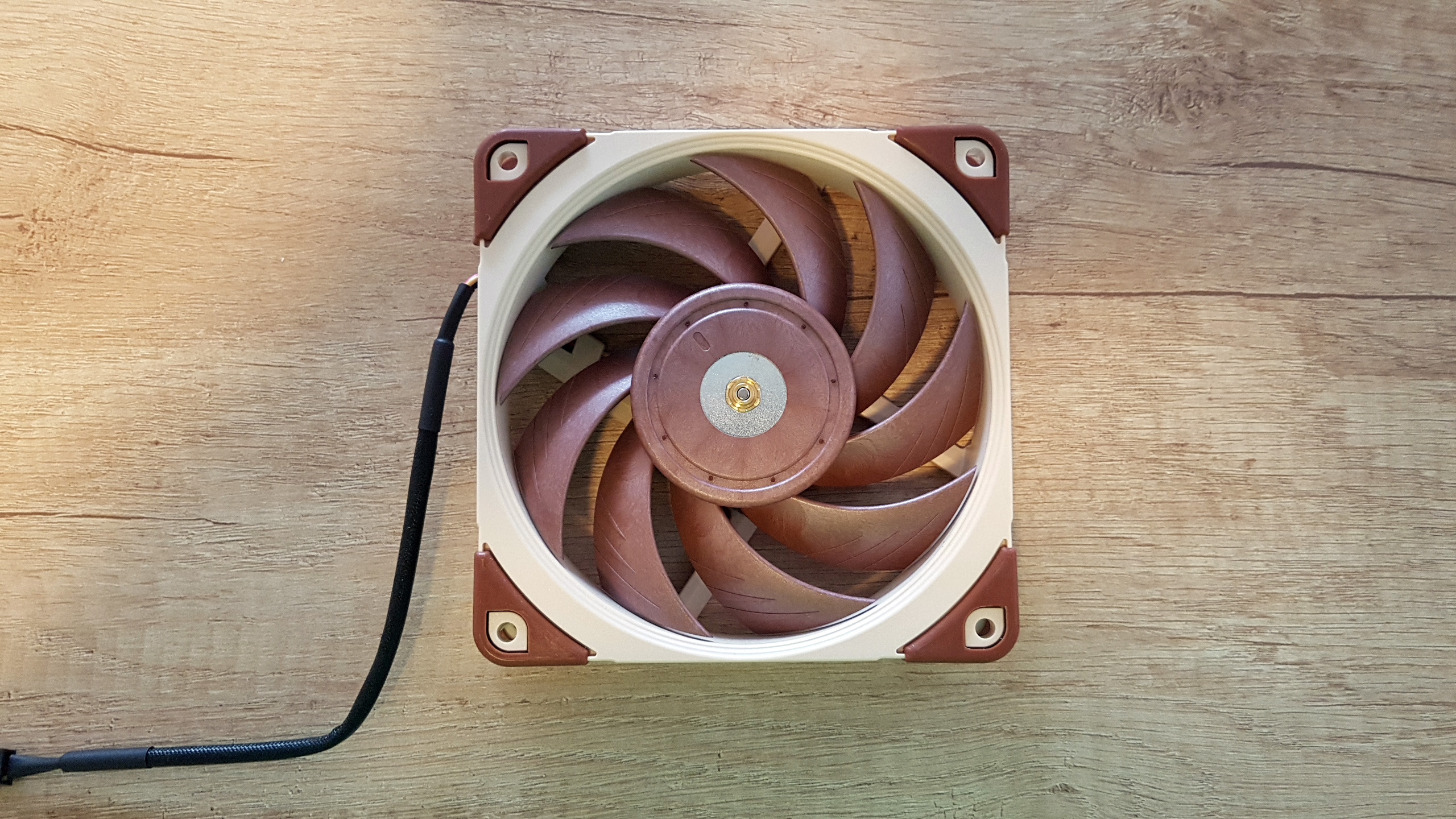
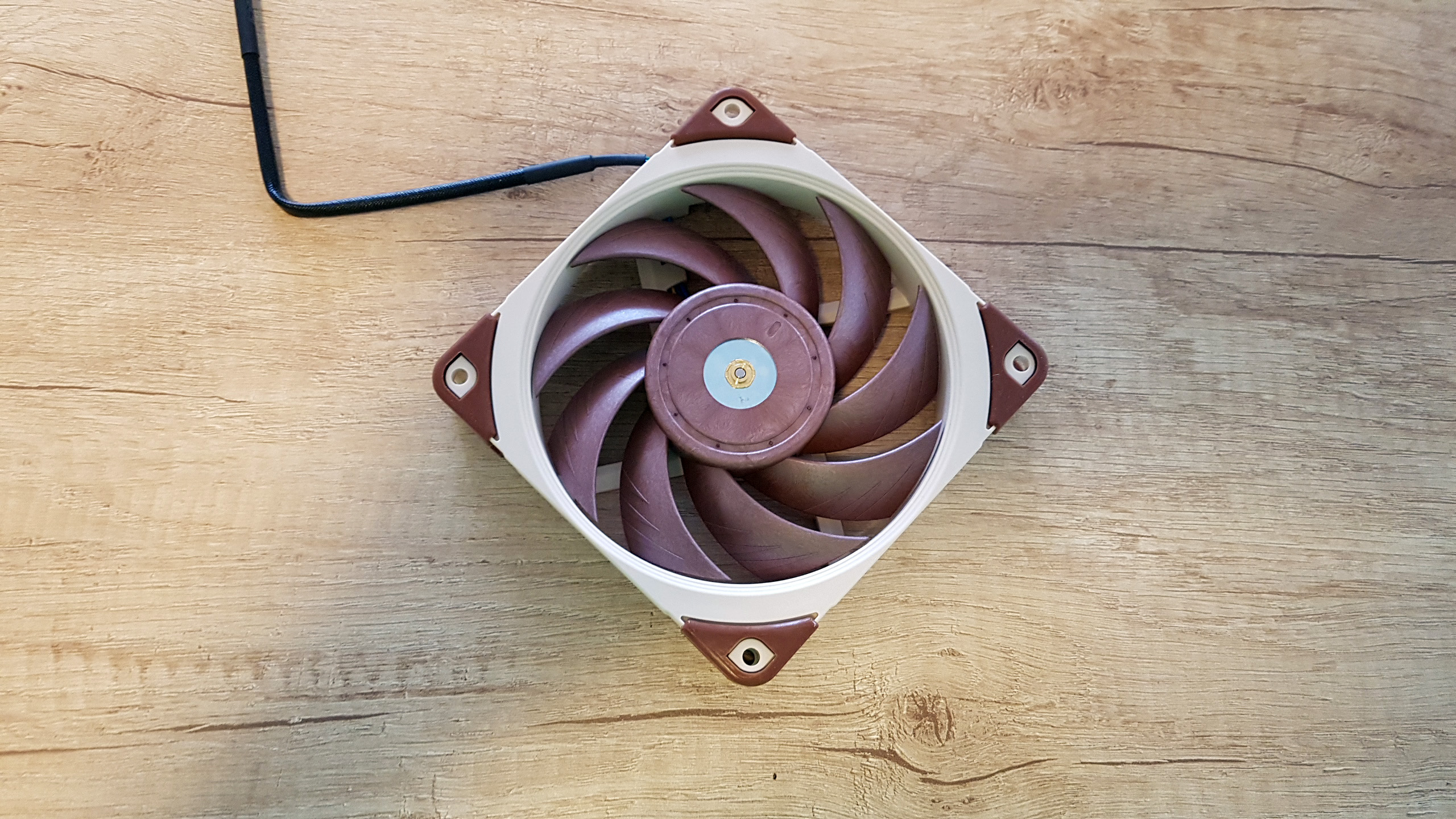
| NF-A12x25 FLX front view | NF-A12x25 ULN front view | NF-A12x25 PWM front view |
 |
 |
 |
Before I describe the propeller of the 3 new fans I would like to mention that all of them are in fact much more sophisticated than the older models. And here come several brand new and very interesting features.
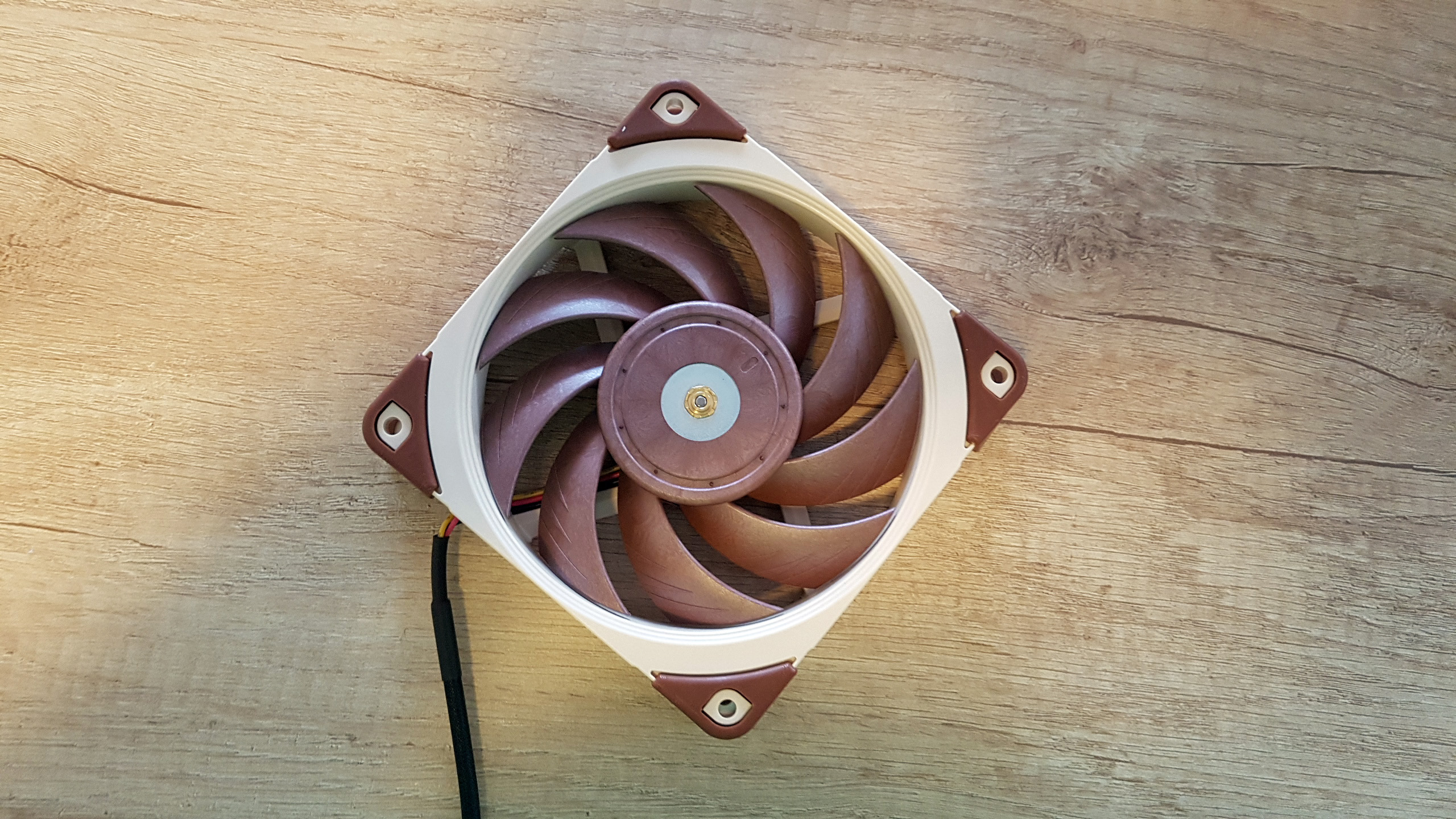
All of the fans are equipped with identical entirely in brown propellers made of the new Sterrox® liquid-crystal polymer compound with 7 pretty narrow and at the same time very sharply angled blades. The LCP material is a compound that offers extreme tensile strength, an exceptionally low thermal expansion coefficient and damping characteristics that are ideal for reducing the resonance and the vibrations in advanced fan-blade designs. And if you payed attention to the pictures above, the color of the propellers is not dense and appears a bit washed. Unfortunatelly, this is a limitation of the new Sterrox material which makes it very difficult to colour and always shows the structure of the crystalline material and fibre glass reinforcements. With this material Noctua is able to deliver stable propeller and lower gap between the blades and the frame, which result in more airflow and better cooling capabilities.
Typically for Noctua, the propeller blades feature suction side Flow Acceleration Channels, which by speeding up the airflow at the crucial outer blade regions will measure in reduced suction side flow separation and thus will lead to better efficiency and lower vortex noise.
The new feature about these models is the ultra-tight tip clearance of only 0.5mm, which is basically the distance between the blade tips and the inside of the frame. This highly ambitious design sets a new benchmark for 120mm fans and helps the NF-A12x25 to work more efficiently against back pressure, such as on heatsinks or radiators, by reducing leak flows through the gap between impeller and frame.
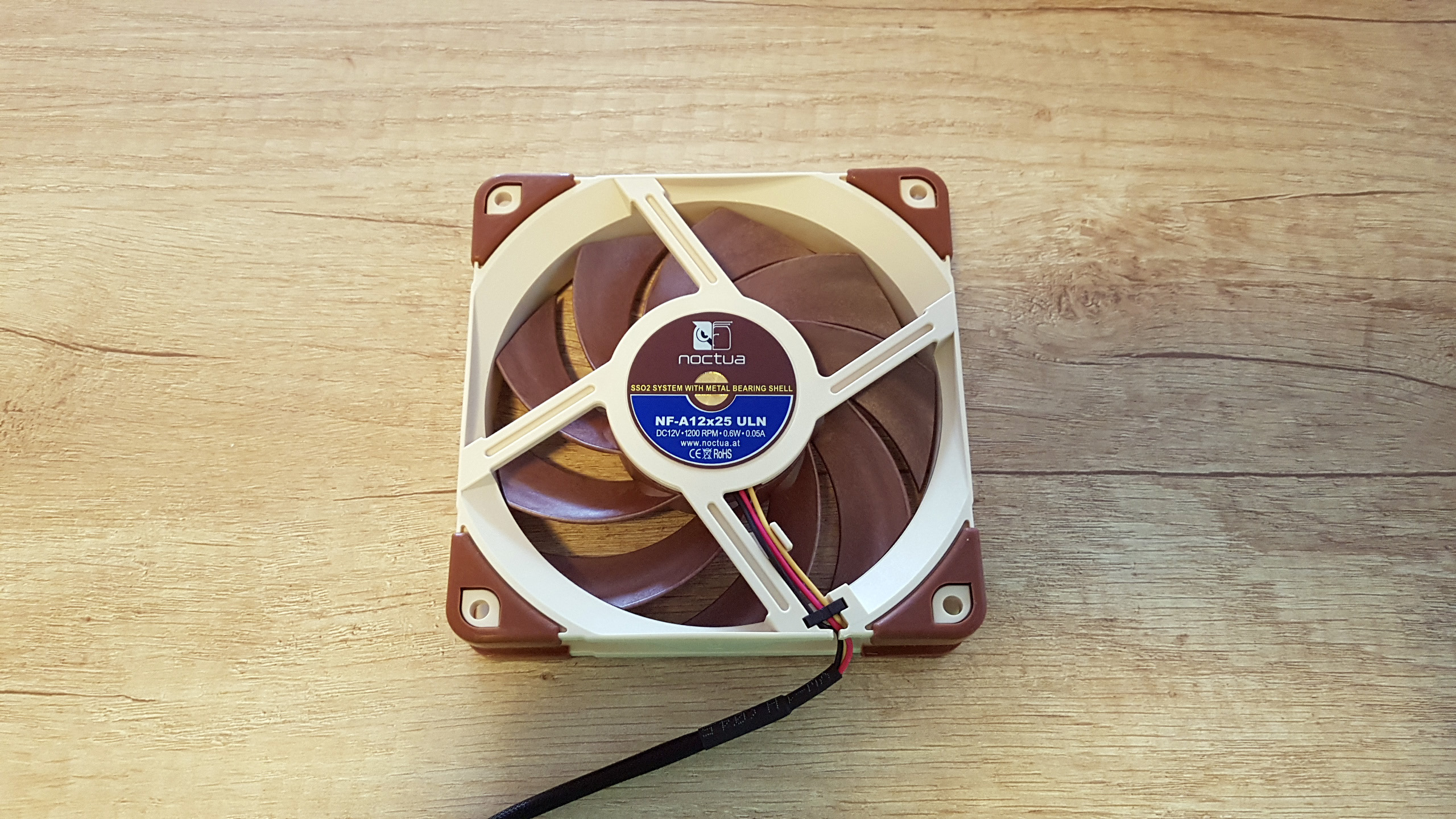
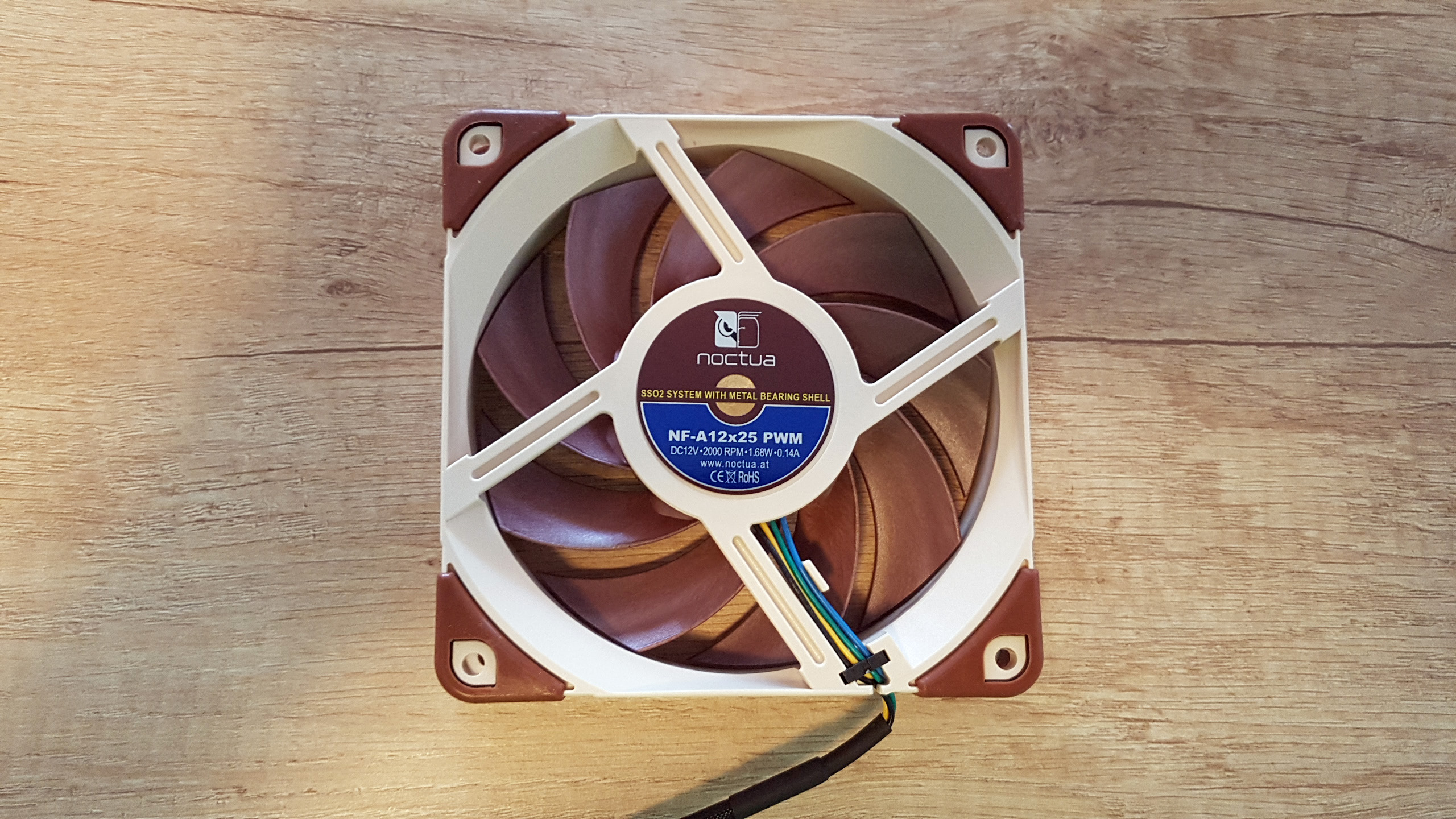
| NF-A12x25 FLX back view | NF-A12x25 ULN back view | NF-A12x25 PWM back view |
 |
 |
 |
And last but not least, I believe it is time to check the connection between the frames and the propellers, aka the motor used so these fans can perform their duties.
All three models are equipped with integrated metal-reinforced motor hub made entirely from steel and the axle mount is reinforced with an additional brass structure. In combination, both measures guarantee ultimate precision and increased stability in the critical hub area.
And by being part of the company’s portfolio all three models are equipped with the typical for all of the series SSO2 bearing, combined with custom-designed NE-FD1 PWM IC that integrates Smooth Commutation Drive (SCD) technology. By providing smoother torque impulses, SCD suppresses PWM switching noises and thus makes the fan quieter at low speeds, made to support fully automatic PWM speed control.
In addition, all of the NF-A12x25 models have been carefully fine-tuned for optimal on-application acoustics to produce smooth, pleasant frequency profile and surprisingly low sound pressure levels (SPL) when working against back pressure.
With all these technologies combined the fans are capable to operate of up to 150 000 hours and are:
NF-A12x25 FLX is 3-pin powered and regulated and works at:
- maximum 2000 +/- 10% revolutions per minute providing airflow level of 102.1 m³/h, static pressure of 2.34 mm H₂O and noise level of 22.6 dB(A).
- with L.N.A. adapter – 1700 +/- 10% revolutions per minute providing airflow level of 84.5 m³/h, static pressure of 1.65 mm H₂O and noise level of 18,8 dB(A).
- with U.L.N.A. adapter – 1350 +/- 10% revolutions per minute providing airflow level of 64.5m³/h, static pressure of 1.05 mm H₂O and noise level of 14.2 dB(A).
NF-A12x25 ULN is 3-pin powered and regulated and works at:
- maximum 1200 +/- 10% revolutions per minute providing airflow level of 55.7 m³/h, static pressure of 0.82 mm H₂O and noise level of 12.1 dB(A).
- with U.L.N.A. adapter – 900 +/- 10% revolutions per minute providing airflow level of 39.4 m³/h, static pressure of 0,41 mm H₂O and noise level of 7.6 dB(A).
NF-A12x25 PWM is 4-pin powered and regulated and works at:
- maximum 2000 +/- 10% revolutions per minute providing airflow level of 102.1 m³/h, static pressure of 2.34 mm H₂O and noise level of 22.6 dB(A).
- with L.N.A. adapter – 1700 +/- 10% revolutions per minute providing airflow level of 84.5 m³/h, static pressure of 1.65 mm H₂O and noise level of 18,8 dB(A).
I believe it is time to put the fans aside and pay more attention to the additional accessories provided in the packages.
Noctua NF-A12x25 FLX , ULN and PWM ACCESSORIES
After checking the fan structures I believe it is time to check the additional accessories added in the packages and accompanying the fans.
| NF-A12x25 FLX | NF-A12x25 ULN | NF-A12x25 PWM |
 |
 |
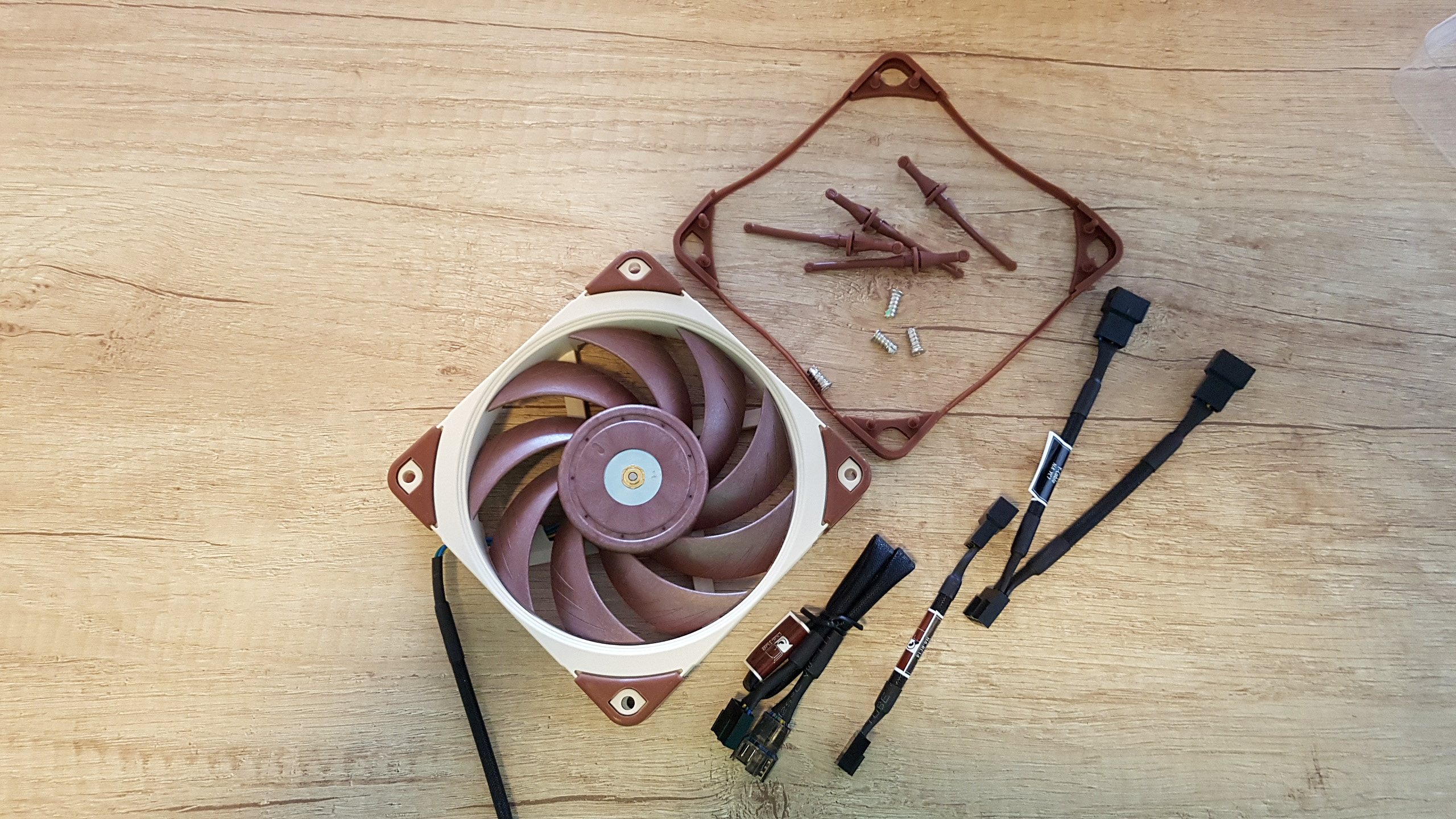 |
And since these are Noctua fans, the provided accessories are a lot and will definitely cover all possibilities and usage scenarios.
Noctua NF-A12x25 FLX:
- Low-Noise Adaptor (L.N.A.)
- Ultra-Low-Noise Adaptor (U.L.N.A.)
- A set of 4 metal screws
- 3:4-pin power supply adaptor
- 30cm extension cable
- NA-AV2 anti-vibration mounts
- Anti-vibration gasket for water cooling radiators
Noctua NF-A12x25 ULN:
- Ultra-Low-Noise Adaptor (U.L.N.A.)
- A set of 4 metal screws
- 3:4-pin power supply adaptor
- 30cm extension cable
- NA-AV2 anti-vibration mounts
- Anti-vibration gasket for water cooling radiators
Noctua NF-A12x25 PWM:
- Low-Noise Adaptor (L.N.A.)
- A set of 4 metal screws
- 4-pin y-splitter cable
- 30cm extension cable
- NA-AV2 anti-vibration mounts
- Anti-vibration gasket for water cooling radiators
Wow, those are really extensive accessories packs, which definitely provide a lot of options for these fans to be used in various setups and which definitely show care to the customer. Pretty nice….
I believe the time has arrived to install the three fans on my test stand and check out how they will perform.
Noctua NF-A12x25 FLX , ULN and PWM TESTS
The tests will be conducted in my standard way. I will install the fans and test them at 5V/7V/9V/12V and my goal will be to check the performance of the products in real conditions. They will be tested under close-to-perfect conditions, not taking into account any external factors. The results achieved during the test can in no way be the same if the models are mounted on a cooler or on the case fan slot of any modern computer case. I will measure the amount of air going through the fans for one hour and their speed. For this I use a fan controller, a voltage meter, an anemometer and a stand made specifically for this purpose.
And this is what the fans look like installed on my test stand:
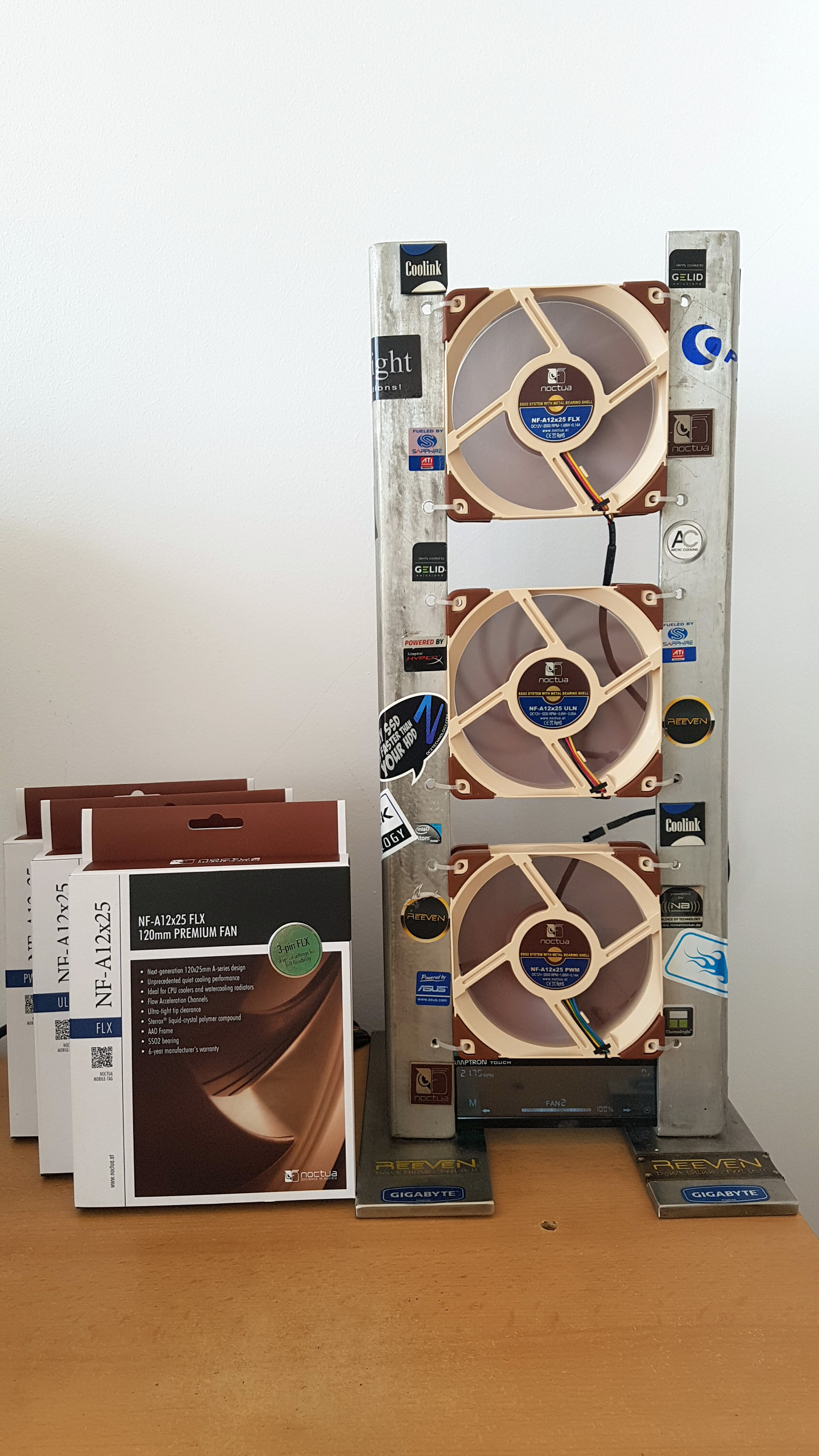
The test results are shown in the following charts:
Airflow through the fans at 5V, 7V, 9V, 12V

Propeller rpm during the tests at 5V, 7V, 9V, 12V.

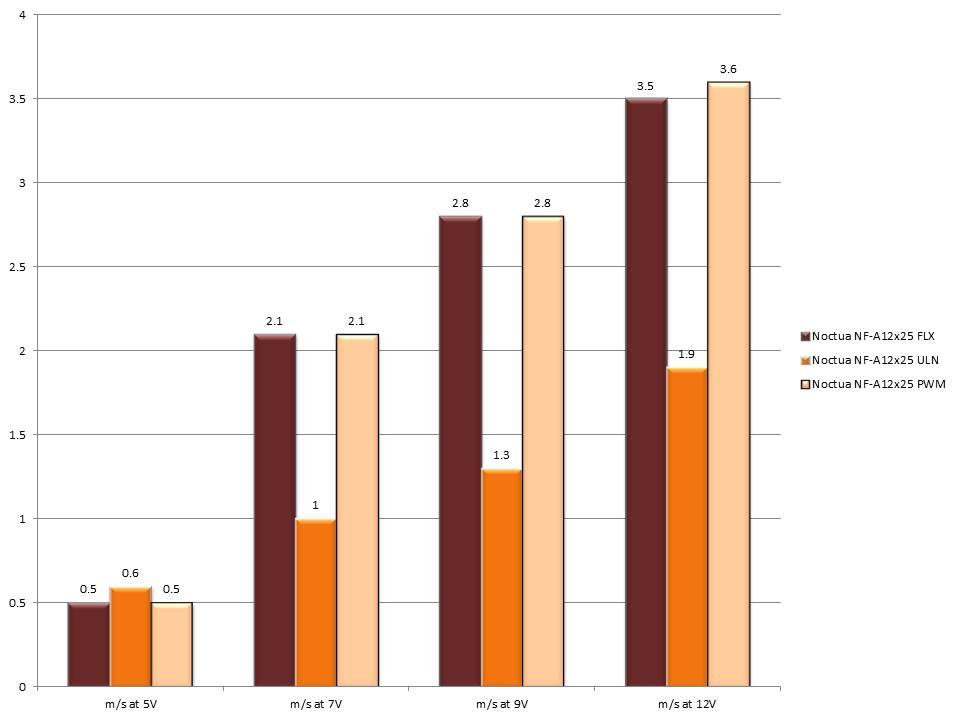
The anemometer showed the following air speed passing through the propellers:
After mounting the fans onto the stand, and leaving them to rotate for about 60 minutes at maximum speed, it was time for the tests to begin.
As with my other tests, again I started with a gradual increase of the voltage through the Lamptron FCT starting at 0V and Noctua NF-A12x25 FLX and Noctua NF-A12x25 PWM made at least one stable revolution at about 5V, while NF-A12x25 ULN started rotating at 7V. Of course, to do the tests I had to set the operational voltage to 5V for all 3 fans.
Through the first test conducted at exactly 5V:
- Noctua NF-A12x25 FLX was rotating at 360 revolutions per minute, providing stable airflow of 18.24 cubic meters per hour
- Noctua NF-A12x25 ULN was rotating at 470 revolutions per minute, providing stable airflow of 21.12 cubic meters per hour
- Noctua NF-A12x25 PWM was also rotating at 360 revolutions per minute, delivering stable airflow of 18.24 cubic meters per hour
All of the fans were dead quiet.
At the second test conducted at exactly 7V:
- Noctua NF-A12x25 FLX was rotating at 1290 revolutions per minute, providing stable airflow of 76.32 cubic meters per hour
- Noctua NF-A12x25 ULN was rotating at 720 revolutions per minute, providing stable airflow of 35.52 cubic meters per hour
- Noctua NF-A12x25 PWM was also rotating at 1290 revolutions per minute, delivering stable airflow of 76.32 cubic meters per hour
All of the fans were performing their duties without generating any noise at all.
At the third test conducted at 9V,
- Noctua NF-A12x25 FLX was running at 1635 revolutions per minute, delivering constant airflow of 99.36 cubic meters per hour
- Noctua NF-A12x25 ULN was rotating at 915 revolutions per minute, providing constant airflow of 48.48 cubic meters per hour
- Noctua NF-A12x25 PWM was running at 1650 revolutions per minute, delivering stable airflow of 100.32 cubic meters per hour
At this test all of the fans were performing their duties without generating any noise at all.
At the last test conducted at 12V, all fans reached their maximum performance, which is:
- Noctua NF-A12x25 FLX was rotating at 2055 revolutions per minute, providing stable airflow of 127.68 cubic meters per hour
- Noctua NF-A12x25 ULN was running at 1200 revolutions per minute, providing constant airflow of 68.64 cubic meters per hour
- Noctua NF-A12x25 PWM was running at 2100 revolutions per minute, delivering stable airflow of 130.56 cubic meters per hour
At this test, the first and the last models started generating a tiny noise, while the second fan was absolutely quiet.
Noctua NF-A12x25 FLX , ULN and PWM CONCLUSIONS
1. Noctua NF-A12x25 FLX , ULN and PWM Performance:
Noctua NF-A12x25 FLX ,NF-A12x25 ULN and NF-A12x25 PWM are three very attractive and very reliable products, in which I’ve invested quite time to complete this test and review. I truly see all these hours as purely quality time, since I was able to see very interesting and sophisticated fan structures realized by a lot of innovative technologies, delivering amazing cooling performance and a lot of capabilities.
NF-A12x25 FLX and NF-A12x25 PWM are basically the same model with only one difference – the powering method. Both fans are definitely very serious performers designed and manufactured with a wide operational range to deliver outstanding balance between airflow, static pressure and noise level to cool every 120mm fan compatible heat sink or water cooling radiator, which will keep high grade processors working with full load at normal, high or extremely high overclocked frequencies. For me, the smaller gap between the frames and propellers plus the additional silicone gasket are two bright ideas, which will push the limits and will significantly increase the overall cooling capabilities of these models.
On the other hand, NF-A12x25 ULN itself is the product designed to deliver airflow, which is more than enough so the fan can be installed on a 120mm case fan slot to boost the overall airflow inside every small, middle or big tower case and keep the hardware inside at decent operational temperatures. Yes, this fan might also handle heatsink cooling but only for low or middle grade processors working at default frequencies.
The performance of all three fans is really nice, but the thing, which actually made me WOW is their operational noise level. In my experience, almost all 120mm fans from various brands usually start generating audible noise at about 1200 revolutions per minute. But for these models, things are slightly different.
NF-A12x25 FLX and NF-A12x25 PWM were absolutely quiet through the first three tests and started generating a tiny noise coming out of the air passing through the propellers above 1800 revolutions per minute. Something which I see for the first time and, to be honest, I was having a hard time to believe it. And yes, with only 1200 revolutions per minute NF-A12x25 ULN was dead quiet through all the tests. I guess all those technologies for noise reduction are working flawlessly.
There is no doubt that all three fans strictly follow the company’s high quality standards and there is no doubt they are a bit pricey. Still, all three models are definitely worth every single cent and I believe with all those technologies listed on the back of the packages combined together they are working really well and push to new standards.
2. Noctua NF-A12x25 FLX , ULN and PWM Appearance:
All of the three fans offer absolutely identical design featuring very rigid looking frame and propeller structure made to provide a pretty serious performance boost. Here again we have the standard Noctua colour scheme which looks interesting but still not very suitable for all modern cases in various sizes and shapes, and most of all different coloured hardware inside them with or without LED back light. The thing, which I didn’t really enjoy, is the washed out propeller coloring, but it seems this is an acceptable limitation of the Sterrox® liquid-crystal polymer compound, which on the other hand leads to much better cooling performance. A sacrifice, which I am willing to take.
I think Noctua NF-A12x25 FLX and Noctua NF-A12x25 PWM deserve the following reward:

While Noctua NF-A12x25 ULN deserve:

Noctua NF-A12x25 FLX , ULN and PWM been added to the 120mm fans catalogue.
Official price (MSRP): Noctua NF-A12x25 FLX : 29.90 euro
Official price (MSRP): Noctua NF-A12x25 ULN : 29.90 euro
Official price (MSRP): Noctua NF-A12x25 PWM : 29.90 euro
Warrnaty: 72 months
Special thanks, Noctua, for the test sample.

Hi,
Thanks for doing this.
A few suggestion/comments:
(1) Noise: It would be useful to measure the noise, since that’s what you are paying for in the end with Noctua.
You can buy a reasonable noise meter from UNIT-T: UT353BT (Bluetooth).
I have this, I think it’s very good quality for the price.
(2) Test details: can you please give a few more details about your test set-up?
As in:
– what instruments you used (I’m assuming the airspeed is in m/sec?)
– where you measured the air flow (distance away from fan)
– how much space there was in front, and behind the fans (it’s quite important to have a largew uninterupted volume on the suction side, is not as critical on the discharge)
(3) Analysis:
If you like, you can squeeze a bit more value out of your work by calculating a few factors:
– Volumetric Blade Efficiency: Air Flow per Fan Revolution
– Energy Blade Efficiency: Air Flow per Watt (electrical)
First of all,thanks for the review
A question on my mind:
Is stock Cooler for AMD4 socket CPUs with “nf a12x25” as fan case enough for process cooling if we go for 8-16 cores in a system? for RGB i would just buy some OEM 5$ ones plus helping 1-3’C degrees overall
thanks in advance