

For the past several years I had the chance to test and review the huge Noctua variety of fans, which already features several pretty solid and well performing fan series. That also includes the Redux series, which was recently upgraded with 4 brand new models. A product line which represents the idea of very well performing fans featuring the iconic Noctua technologies, stripped from additional accessories and fancy packages to deliver more affordable prices.
The Redux series has constantly been developed and expanded for the past several years and already offers a wide range of models with various dimensions and performance capabilities:
The latest addition to the series are the models NF-P12 redux operating in the range 900 up to 1700 revolutions per minute, 3-pin or 4-pin PWM powered and regulated.

For this test and review I’ve received all four NF-P12 redux fans, which arrived to me packed inside the typical pretty simple and very stylish Redux carton box painted in the grey and brown colour scheme.
On the front side of the boxes there are a small company logos, accompanied by the series name, the size of the fans and the model names.
Of course, the full technical specifications regarding the products are located on the back of the packages printed on a white sticker and attached to the packages.
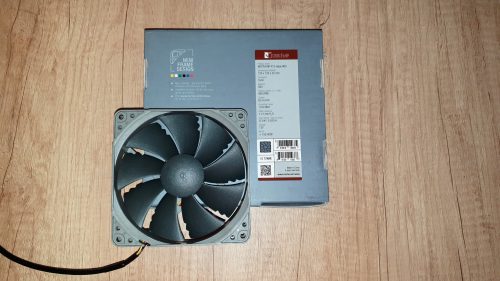
NF-P12 redux 900 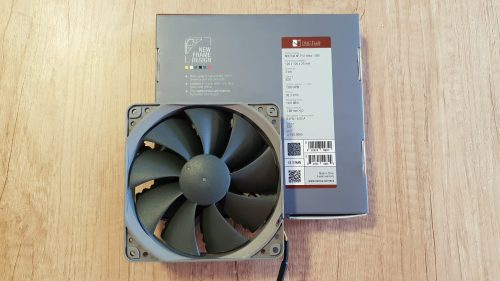
NF-P12 redux 1300 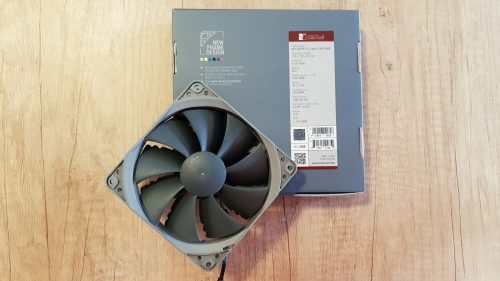
NF-P12 redux 1300 PWM 
NF-P12 redux 1700 PWM
According to the official technical details all of the fans are with identical frame and propeller structure, technologies integrated and the only difference are the powering and regulation methods and the performance capabilities.
So let’s proceed with checking the fan structures.
Noctua NF-P12 redux 900 – 1700 PWM Structure
All of the fans are designed with absolutely identical thick, pretty solid, square 120 x 25mm frames, entirely in gray, with a 105 x 105mm screw hole pattern. On each side of the frames there are slots to install anti-vibration pads and since they are not included in the package the fans can be combined with any of the NA-SAVP1 anti-vibration pads. In addition the information stickers on the back of the fans are completely redesigned and also there is a small cut through which we can see the stabilization magnet of the bearing.
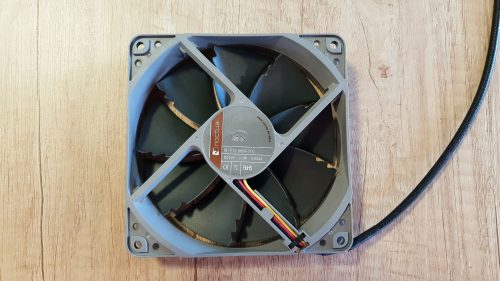
NF-P12 redux 900 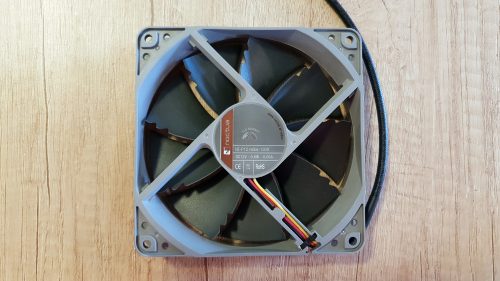
NF-P12 redux 1300 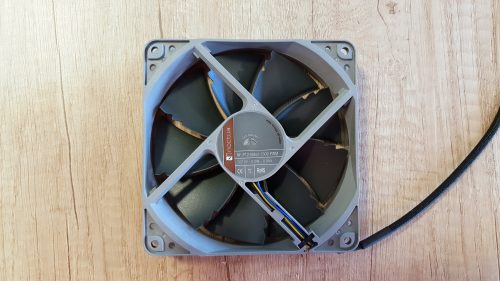
NF-P12 redux 1300 PWM 
NF-P12 redux 1700 PWM
In addition, the information stickers on the back of the fans are completely redesigned and also there is a small cut through which we can see the stabilization magnet of the bearing.
And since I’ve mentioned the motor, let’s check its structure.
All of the fans are equipped with the iconic Noctua SSO2 bearing, which is combined with the proven concept of hydrodynamic bearing with an additional magnet that supports the self-stabilization of the rotor axis. And by being paired with the Smooth Commutation Drive 2 system it ensures superb running smoothness by eliminating the torque variations and switching noises. System, which is designed to make the fans extremely quiet even at very close distances.
Of course the PWM version are also equipped with the custom-designed NE-FD1 PWM IC that integrates Smooth Commutation Drive (SCD) technology. Also the PWM models are capable to fully stop at 0% PWM duty cycle by the mainboard or PWM fan controller. This feature make the PWM models the perfect choice when designing and building semi-passive cooling setups that automatically turn the fans off and thus run completely silent at idle if thermals allow.

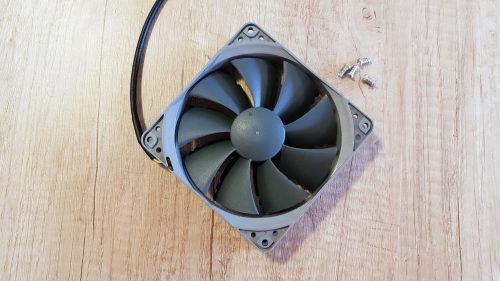
And last but not least, all of the fans are supplied with identical entirely in dark grey propellers with 9 pretty wide and at the same time not very sharply angled blades. The blades themselves are especially developed for applications such as CPU coolers, water-cooling radiators or cases with tight fan grills, which require high static pressure and airflow performance.
And since these are Noctua fans the propeller blades feature Noctua’s signature Vortex-Control Notches split up trailing edge vortices and thus spread the fan’s noise emission over a wider range of frequencies. This measure makes the fan sound more pleasant to the human ear.
With these technologies combined the fans are capable to operate of up to 150 000 hours and are:
Noctua NF-P12 redux 900 is 3-pin powered and regulated to work at maximum 900 +/- 10% revolutions per minute delivering airflow level of 63.4 m³/h, static pressure of 1.21 mm H₂O and noise level of 12.6 dB(A).
Noctua NF-P12 redux 1300 is 3-pin powered and regulated to operate at maximum 1300 +/- 10% revolutions per minute providing airflow level of 92.3 m³/h, static pressure of 1.68 mm H₂O and noise level of 19.8 dB(A).
Noctua NF-P12 redux 1300 PWM is 4-pin powered and regulated and works at maximum 1300 +/- 10% revolutions per minute providing airflow level of 92.3 m³/h, static pressure of 1.68 mm H₂O and noise level of 19.8 dB(A).
Noctua NF-P12 redux 1700 PWM is 4-pin powered and regulated and works at maximum 1700 +/- 10% revolutions per minute providing airflow level of 120.2 m³/h, static pressure of 2.83 mm H₂O and noise level of 25.1 dB(A).
Noctua NF-P12 redux 900 – 1700 PWM ACCESSORIES
After checking the fan structures I believe it is time to check the additional accessories added in the packages and accompanying the fans.
NF-P12 redux 900 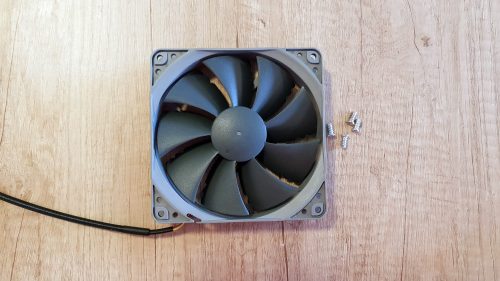
NF-P12 redux 1300 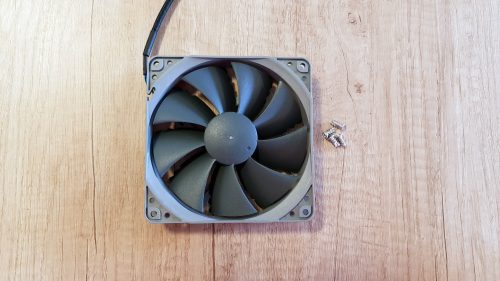
NF-P12 redux 1300 PWM 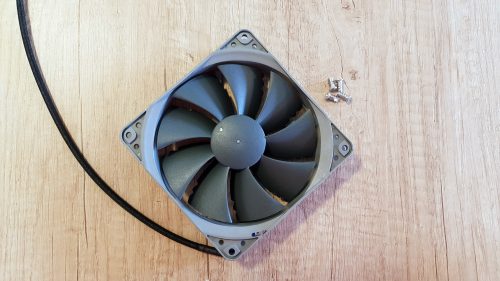
NF-P12 redux 1700 PWM
Be being part of the Redux series all four models are supplied with a very simple accessories pack which features only one set of four installation screws to attach the fan to a case fan slot
I believe the time has arrived to install all of the fans on my test stand in pairs since it can handle only 3 fans at a time and check out how they will perform.
Noctua NF-P12 redux 900 – 1700 PWM TESTS
The tests will be conducted in my standard way. I will install the fans and test them at 5V/7V/9V/12V and my goal will be to check the performance of the products in real conditions. They will be tested under close-to-perfect conditions, not taking into account any external factors. The results achieved during the test can in no way be the same if the models are mounted on a cooler or on the case fan slot of any modern computer case. I will measure the amount of air going through the fans for one hour and their speed. For this I use a fan controller, a voltage meter, an anemometer and a stand made specifically for this purpose.
And this is what the fans look like installed on my test stand:

NF-P12 redux 900 – 1300 
NF-P12 redux 1300 – 1700 PWM
The test results are shown in the following charts:
Airflow through the fans at 5V, 7V, 9V, 12V

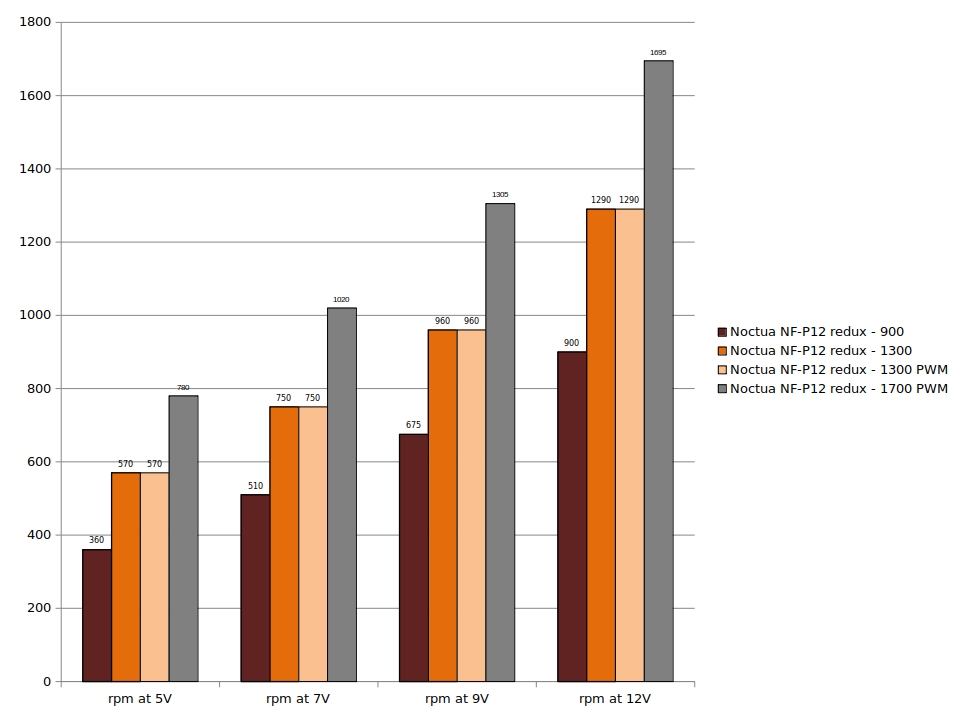
Propeller rpm during the tests at 5V, 7V, 9V, 12V.
The anemometer showed the following air speed passing through the propellers:

After mounting the fans onto the stand, and leaving them to rotate for about 60 minutes at maximum speed, it was time for the tests to begin.
As with my other tests, again I started with a gradual increase of the voltage through the Lamptron FCT starting at 0V and all of the fans made at least one revolution per minute at about 5.5V. Of course, to do the tests I had to slightly decrease the operational voltage to 5V and start measuring.
Through the first test conducted at exactly 5V:
- NF-P12 redux 900 was rotating at 360 revolutions per minute, providing stable airflow of 22.56 cubic meters per hour
- NF-P12 redux 1300 was rotating at 570 revolutions per minute, providing stable airflow of 36.96 cubic meters per hour
- NF-P12 redux 1300 PWM was also rotating at 570 revolutions per minute, delivering stable airflow of 36.96 cubic meters per hour
- NF-P12 redux 1700 PWM was rotating at 780 revolutions per minute, delivering stable airflow of 54.24 cubic meters per hour
All of the fans were absolutely quiet.
At the second test conducted at exactly 7V:
- NF-P12 redux 900 was rotating at 510 revolutions per minute, providing stable airflow of 32.64 cubic meters per hour
- NF-P12 redux 1300 was rotating at 750 revolutions per minute, providing stable airflow of 52.8 cubic meters per hour
- NF-P12 redux 1300 PWM was also rotating at 750 revolutions per minute, delivering stable airflow of 51.36 cubic meters per hour
- NF-P12 redux 1700 PWM was rotating at 1020 revolutions per minute, delivering stable airflow of 71.52 cubic meters per hour
All of the fans were running without generating any noise at all.
At the third test conducted at 9V,
- NF-P12 redux 900 was running at 675 revolutions per minute, providing stable airflow of 47.04 cubic meters per hour
- NF-P12 redux 1300 was running at 960 revolutions per minute, providing stable airflow of 68.64 cubic meters per hour
- NF-P12 redux 1300 PWM was also running at 960 revolutions per minute, delivering stable airflow of 68.64 cubic meters per hour
- NF-P12 redux 1700 PWM was running at 1305 revolutions per minute, delivering stable airflow of 94.56 cubic meters per hour
At this test the first 3 fans were performing their duties without generating , while the fastest model started generating a tiny noise coming from the air passing through the propeller.
At the last test conducted at 12V, all fans reached their maximum performance, which is:
- NF-P12 redux 900 was running at 900 revolutions per minute, providing stable airflow of 64.32 cubic meters per hour
- NF-P12 redux 1300 was running at 1290 revolutions per minute, providing stable airflow of 93.12 cubic meters per hour
- NF-P12 redux 1300 PWM was also running at 1290 revolutions per minute, delivering stable airflow of 93.12 cubic meters per hour
- NF-P12 redux 1700 PWM was running at 1695 revolutions per minute, delivering stable airflow of 123.36 cubic meters per hour
At this test, the first model remained silent. The 1300RPM versions started generating just a bit of noise, while the 1700 version was pretty loud.
Noctua NF-P12 redux 900 – 1700 PWM CONCLUSIONS
1. Noctua NF-P12 redux 900 – 1700 PWM Performance:
I believe I’ve spent really a lot of quality time having fun with the latest models added to the Redux series. Models which follow the company standards to feature the wide range of Noctua’s technologies combined together to deliver the best possible airflow level/ static pressure level and noise level balance at affordable package price.
NF-P12 redux 900 is the slowest model from the latest arrivals entirely made to be installed as a case fan to boost the overall airflow level inside every modern case. The fan itself is absolutely quiet even at full speed, which makes it a good choice for SFF or HTPC systems.
On the other hand, NF-P12 redux 1300 and NF-P12 redux 1300 PWM are the versatile versions designed to work as case fans when set to operate at lower voltage and at the same time are capable to be a main cooling unit for CPU cooler heat sinks or water cooling radiators when cooling processors working at default or a bit overclocked frequencies. The fans are very quiet, when working at low operational voltage and generate a tiny noise coming out of the air passing through the propellers when working at full speed.
And last but not least, NF-P12 redux 1700 PWM is definitely the best performer from the latest arrivals. It is a fan which is pretty loud at full speed but definitely capable to deliver enough airflow level and static pressure level to keep every modern processor working stable at default and overclocked frequencies.
There is no doubt that all of the NF-P12 redux fans strictly follow the company’s high quality standards featuring a set of pretty sophisticated technologies. As a disadvantage I can mention the accessories pack, which feature only 4 screws and the lack of anti-vibration pads, but still we have to admit that these models are the budget orientated Noctua products, which are made to deliver serious cooling performance by sacrificing some of the extras.
2. Noctua NF-P12 redux 900 – 1700 PWM Appearance:
All of the fans offer absolutely identical very solid and at the same time very simple looking frame and propeller structure. Combined together with the 2 shades of gray colour scheme they will definitely stay neutral in every modern case just to provide the airflow and stay out of sight.
I think Noctua NF-P12 redux 1300, 1300 PWM and 1700 PWM deserve the following reward:

While Noctua NF-P12 redux 900 deserves:

Noctua NF-P12 redux 900 – 1700 PWM have been added to the 120mm fans catalogue.
Official price (MSRP): NF-P12 redux 900 : 13.90 euro
Official price (MSRP): NF-P12 redux 1300 : 13.90 euro
Official price (MSRP): NF-P12 redux 1300 PWM : 13.90 euro
Official price (MSRP): NF-P12 redux 1700 PWM : 13.90 euro
Warranty: 72 months



