

In February I had the honor to test the Cooler Master Hyper 412S and now, three months later, I received its new and improved version. This time, the model is Cooler Master Hyper 412 Slim, and it arrived in the following packaging:


As you can see from the pictures, the packaging is made of a standard carton box with the company colours – white and purple. Traditionally, the back side of the box enlists the main technical characteristics of the product. Of course, there is the full list of technical specification on the side of the box.
After I opened the box, I found the following elements, nicely individually packed.

What triggered my interest was the big piece of plastic foam, holding the cooler itself. Naturally, I’m going to take a look at the other elements as well but I’ll do it a bit later

I don’t know why but these pictures came out pretty dark.
The cooler is made up of four copper heat pipes directly contacting the CPU, transferring heat from the CPU to the aluminum fins on which there are mounted two slim 120mm fans with the following characteristics: speed 500 – 1.600 rpm (PMW) ±10%, airflow 17.4 – 58.4 CFM ±10%, static pressure 0.18 – 1.76 mm H2O ±10%, and noise level 8 – 30 dBA.

The fans are mounted to the cooler via plastic brackets, which are fixed to the fans, unlike those of previous models. There are also rubber bands on the side of the fans for killing vibrations. Fan power and regulation is done via a 4-Pin PWM connector and the set includes a PMW splitter.

Let us take a closer look at the structure of the cooler. It is almost identical to the one of the previous model, with one slight difference. The heat pipes again are four, again with a diameter of ø6mm and again mounted according to the CDC technology; however, this time they are without coating. I personally expect this to result in temperatures a few degrees lower. The cooler’s size is 132 x 106 x 160mm with the fans mounted and weighs 538 grams.


This is how the contact surface looks like.

After looking at the structure, it is time I took a peek in the second, smaller box. I assume you have all guessed that here is where the mounting kit is, namely:

- Manual for mounting the cooler on Intel and AMD platforms
- Thermal paste
- Universal bracket for mounting the cooler on Intel and AMD platforms
- Mounting kit
- Back plate for mounting
- PMW splitter for plugging two fans
- L-shaped screwdriver
- A booklet describing all the warranty specifications for the different products of the company
In practice, Cooler Master Hyper 412 Slim can be mounted both horizontally and vertically with both platforms via a universal back plate and the well-known long-used X-shaped bracket.
- Intel Socket: LGA 2011 / 1366 / 1156 / 1155 / 775
- AMD Socket: FM1 / AM3+ / AM3 / AM2+ / AM2
I think time has come for me to roll up my sleeves and see what Cooler Master Hyper 412 Slim really can do. Of course, in order to conduct the tests, I had to mount it first, which was quite easy and the end result looked like this:


As you can see from the pictures, after Cooler Master Hyper 412 Slim has been mounted, you can still use all four memory slots, whereby a problem would be only mounting memories with very tall heat sinks.
To keep the tradition, before I move on to the test results, I would like to describe the system, used for the test:
CPU: AMD Athlon X4 620 at standard frequency of 2611 MHz and overclocked at 3640 MHz (at 1.5V) per core for the tests.
Motherboard: GigaByte 790X-UD3P
Video card: Sapphire 5830 Extreme 1GB DDR5 256bit
Memory: 2 x 2GB Apacer 800 MHz
Hard drive: Kingston SSD SV100S264G
Case: Cooler Master HAF 932
Power supply: Cooler Master Silent Pro 600
Cooler: Cooler Master Hyper 412 Slim
Thermal paste: Standard paste from the Cooler Master Hyper 412 Slim set
Fans mounted on the cooler: Standard fans from the set – XtraFlo 120 Slim
The tests were conducted in a closed system with:
- 230mm fan on the front panel putting fresh air in and spinning at about 700 rpm
- 230mm fan on the side panel putting fresh air in and spinning at about 700 rpm
- 230mm fan on the top panel taking hot air out and spinning at about 700 rpm.
- Room temperature of about 18 degrees.
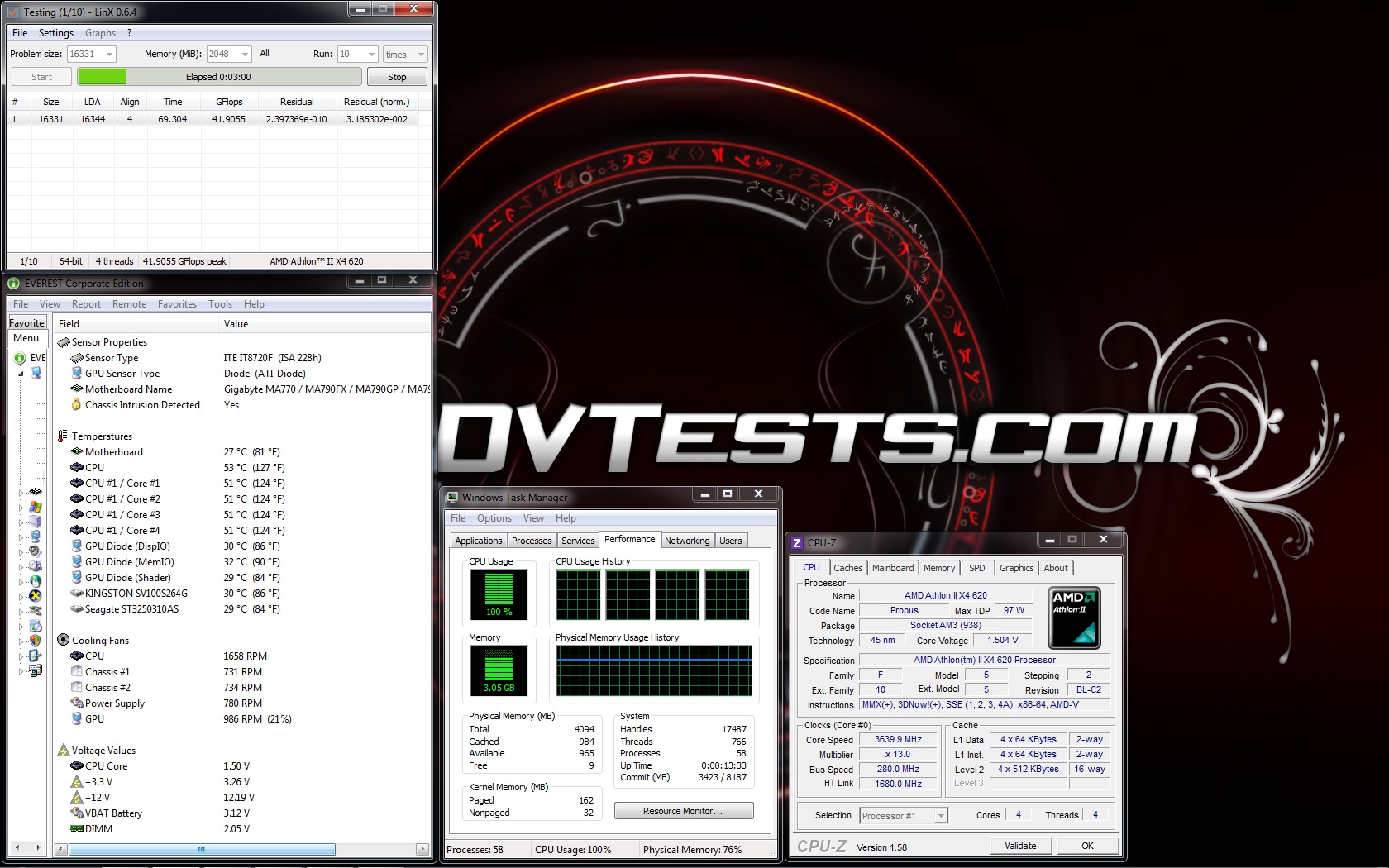
Testing of the CPU was done at full load using Linx at standard (2611MHz) and overclock frequency (3640MHz) in a closed system, and the test aims at showing what temperature the CPU is really reaching. For the test I am going to use the Cooler Master Hyper 412 Slim CPU cooler with the standard fans at around 1600 rpm at standard and overclock frequency, whereby for two of the tests, I will take off one of the fans.

The results from the tests are:
Test with two XtraFlo 120 Slim at around 1600 rpm at standard CPU frequency of 2611MHz:

Test with two XtraFlo 120 Slim at around 1600 rpm at overclock CPU frequency of 3640MHz:
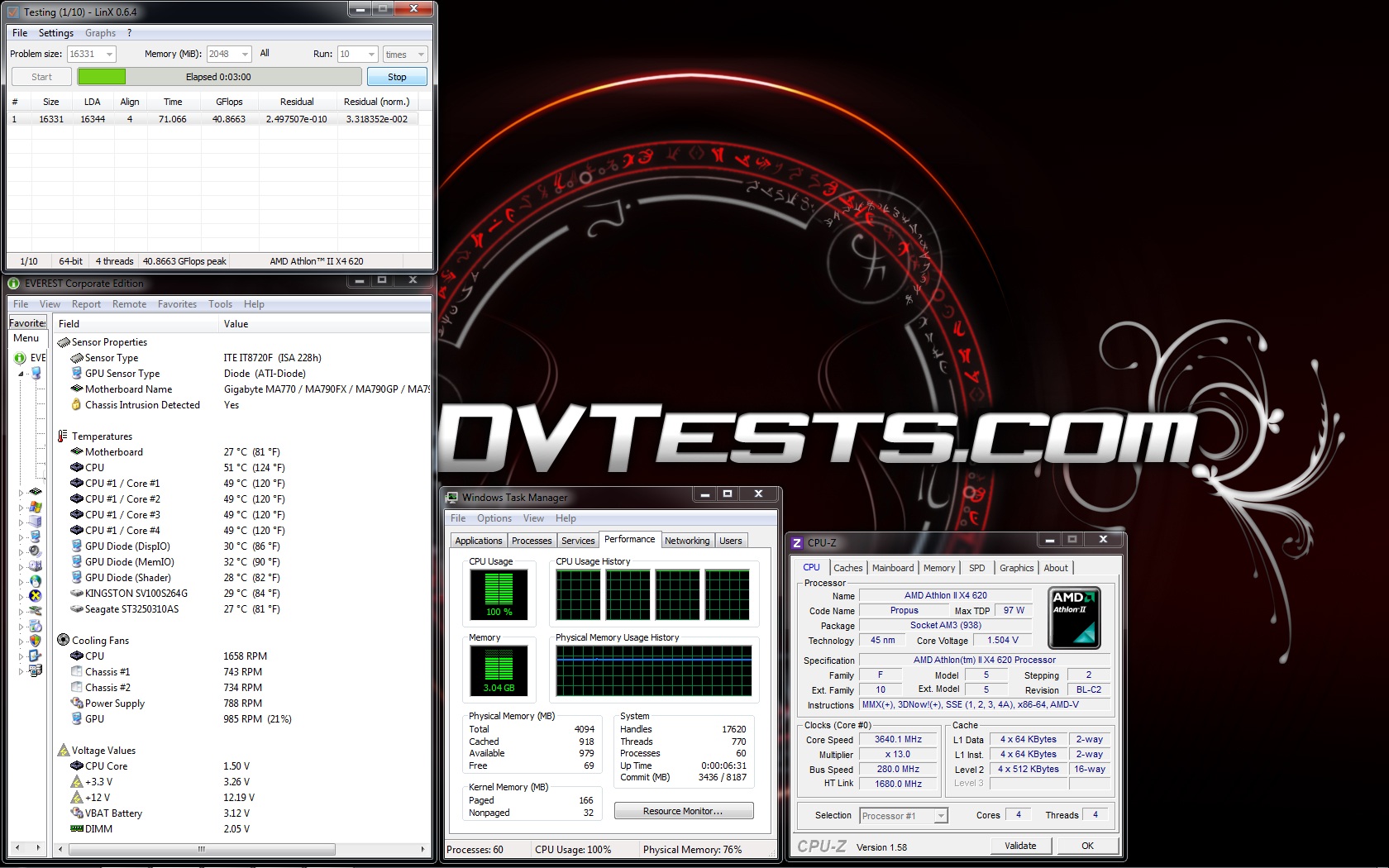
Test with one XtraFlo 120 Slim at around 1600 rpm at standard CPU frequency of 2611MHz:
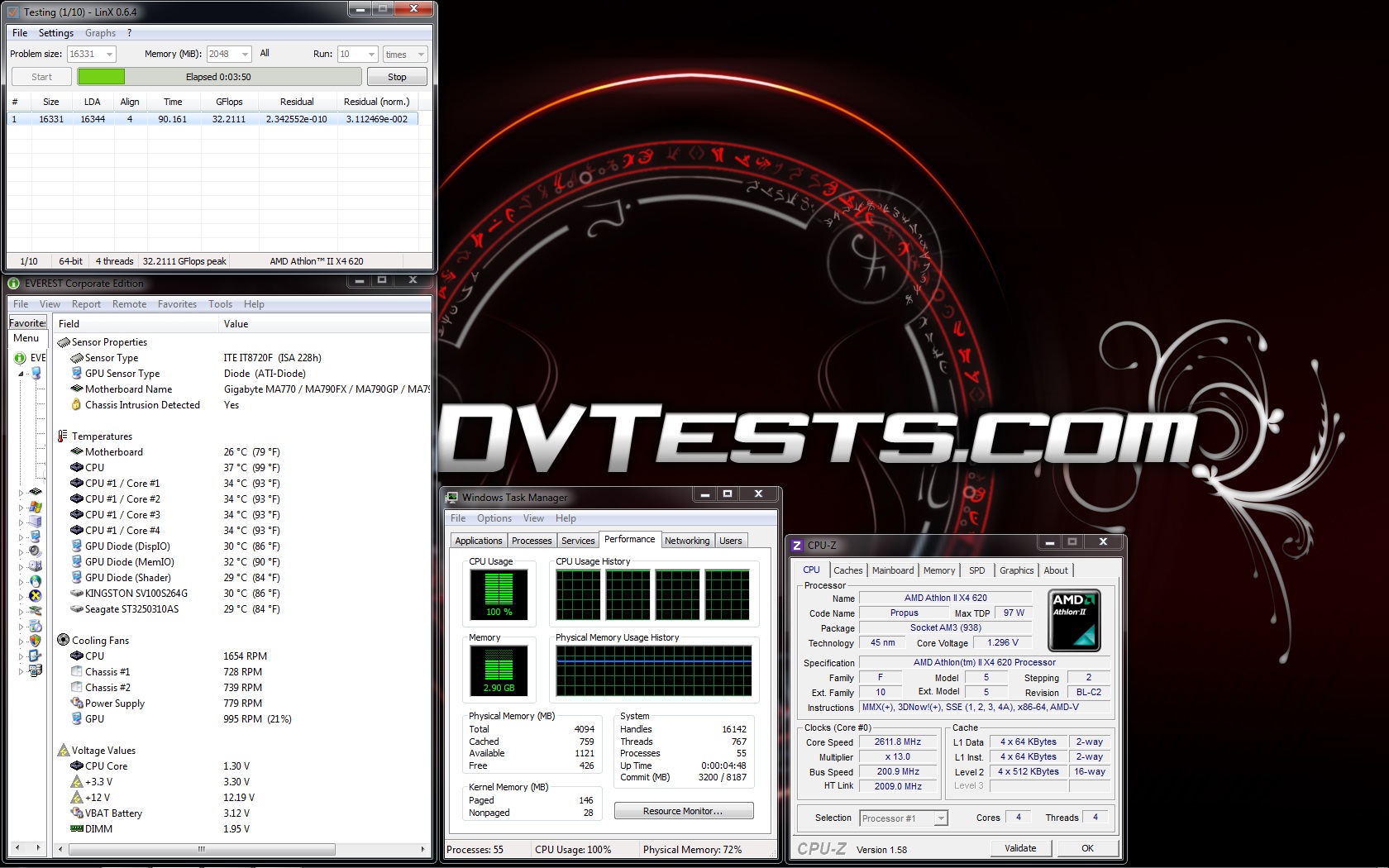
Test with one XtraFlo 120 Slim at around 1600 rpm at overclock CPU frequency of 3640MHz:
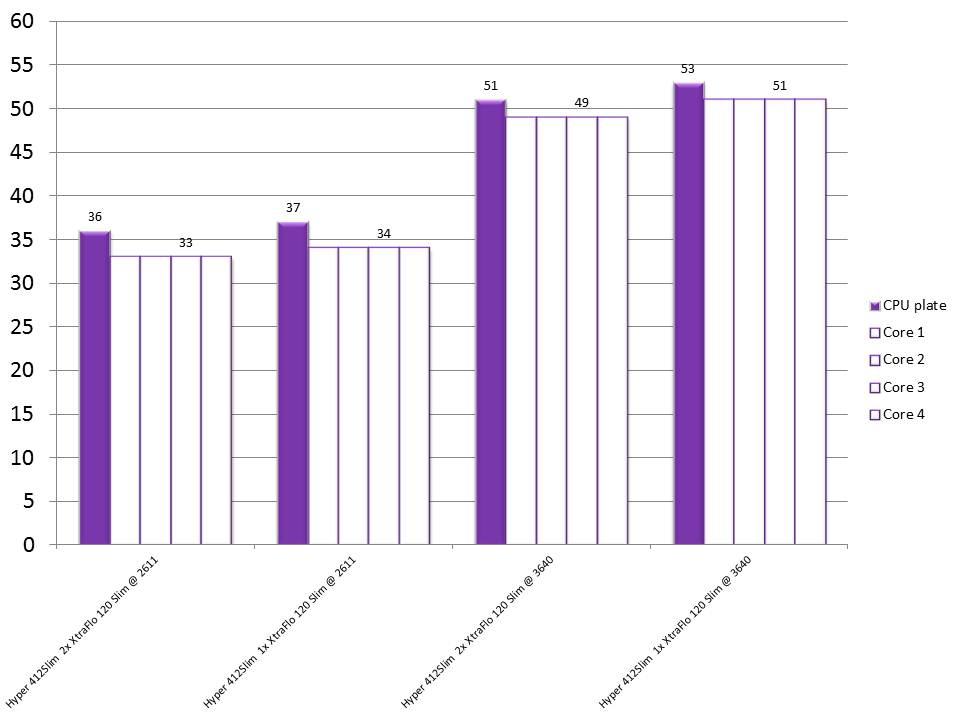
The test results have been summed up in the following charts:
And the fan speed during the tests:

Once again, it is time for me to express my own opinion about the results, the vision and the structure of the cooler, and this time I tested Cooler Master Hyper 412 Slim.
- Hyper 412 Slim, like all of Cooler Master’s new models, has been developed via the CDC™ (Continuous Direct Contact) technology, which as can be seen from the results achieves very good performance. After testing its predecessor Cooler Master Hyper 412S a few months ago, I then came to the conclusion that the model could do more, if the contact area is improved, and now the new model has proven me right. Cooler Master Hyper 412 Slim is the better but unfortunately a bit noisier option, and it is very clear that this one has been manufactured for better performance.
- Like all the other company’s models from the last few months, this one also is mounted via a back plate and an X-shaped bracket, which makes it universal.
- The cooler itself is being cooled by two slim Cooler Master XtraFlo 120 Slim fans working at 500 – 1.600 rpm (PWM) ±10%, which do a great job at cooling the structure, despite the little bit lower airflow compared to standard 25mm fans: 17.4 – 58.4 CFM ±10%. Of course, there is no way that noise levels could be low at this speed; however, they offer PWM regulation, whereby noise levels significantly decrease. I personally prefer these types of fans for you could turn them up when needed and achieve better performance.
- And last but not least, the company has preserved the overall vision of the product, which is very pleasant. Unfortunately, my “professional” photography skills could not show it in the best light, so in order not to make a total fool of myself, here is how the cooler really looks like:

I’ve decided that Cooler Master Hyper 412 Slim deserves the following reward:

I thank Cooler Master for the sample.


@Pepix
Принципно идеята е, че при този модел идва стандартно с два тънки вентилатора с примерно обща дебелина 20мм, докато само 1 обикновен е 25мм, а пък и втори и става страшно.
Да действително има разлика в температурите, но е много малка при ниските честоти.
Иначе старият модел с по-дебелия вентилатор е и с по-голямо ниво на въздушния поток и по-високо статично налягане.
Slim е заради тънките вентили, спестяват 10 мм отпред и още толкова отзад. Целта е да се освободи място за високи памети в близките до сокета слотове при 1155 и 2011. Като представяне ми се виждат ориентировъчно еднакви (като цяло и от други ревюта се вижда разлика 1-2 градуса по-ниска температура при 412S), все пак разликата е единствено в липсата на покритие на топлинните тръби при тънката версия, от което малко е загубил според мен, но най-вероятно е компенсирал и леко от цената на двата вентила.
🙂 Не изглежда много слим като цяло (и по-точно.. доста солидно изглежда) 🙂
Само на мен ли ми се струва, че разликата между един и два вентилатора е доста малка?
Също така оставам с впечатление, че на честотата по подразбиране на процесора се справя малко по-зле от старата версия.. ако е така.. защо ли? Изглежда му трябва повече натоварване за да стане по-ефективен.