

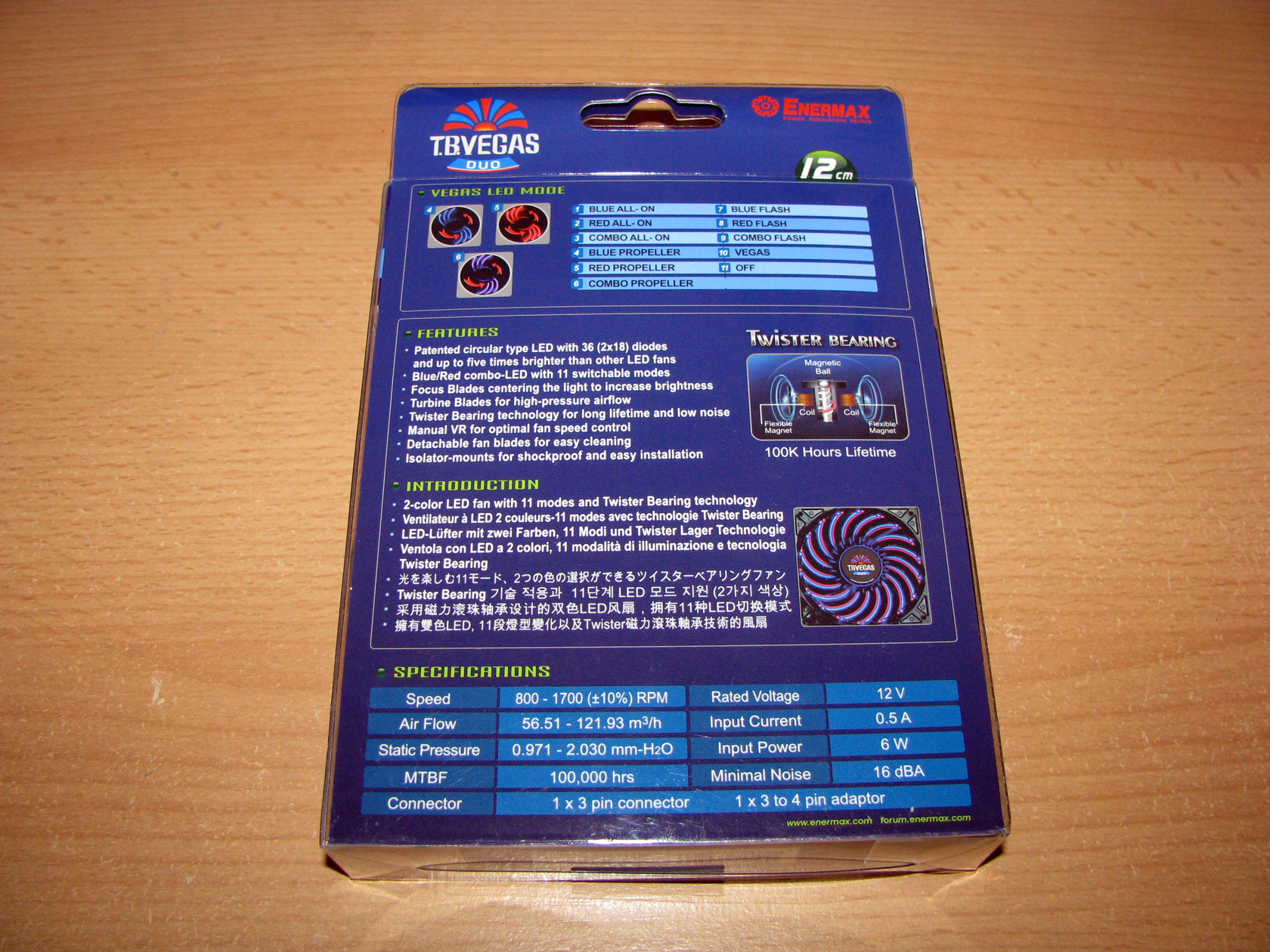
After some time of waiting, the test and review sample I received is Enermax T.B.Vegas DUO with a size of 120mm. As you can see from the picture above, the fan arrived in a transparent plastic box, through which you can see the entire structure of the fan and the carton bed for the fan contains the main technologies used for the manufacturing process. I suppose you all know that the Vegas series offers attractive backlights of several colours shining in several different ways. This specific model offers only red and blue and combinations of these colours. On the front part of the box you can see the fan structure, and on the back you can see all technical characteristics of the product.
There are several interesting points about the fan that I would like to discuss in this article. Let me start with the first one.

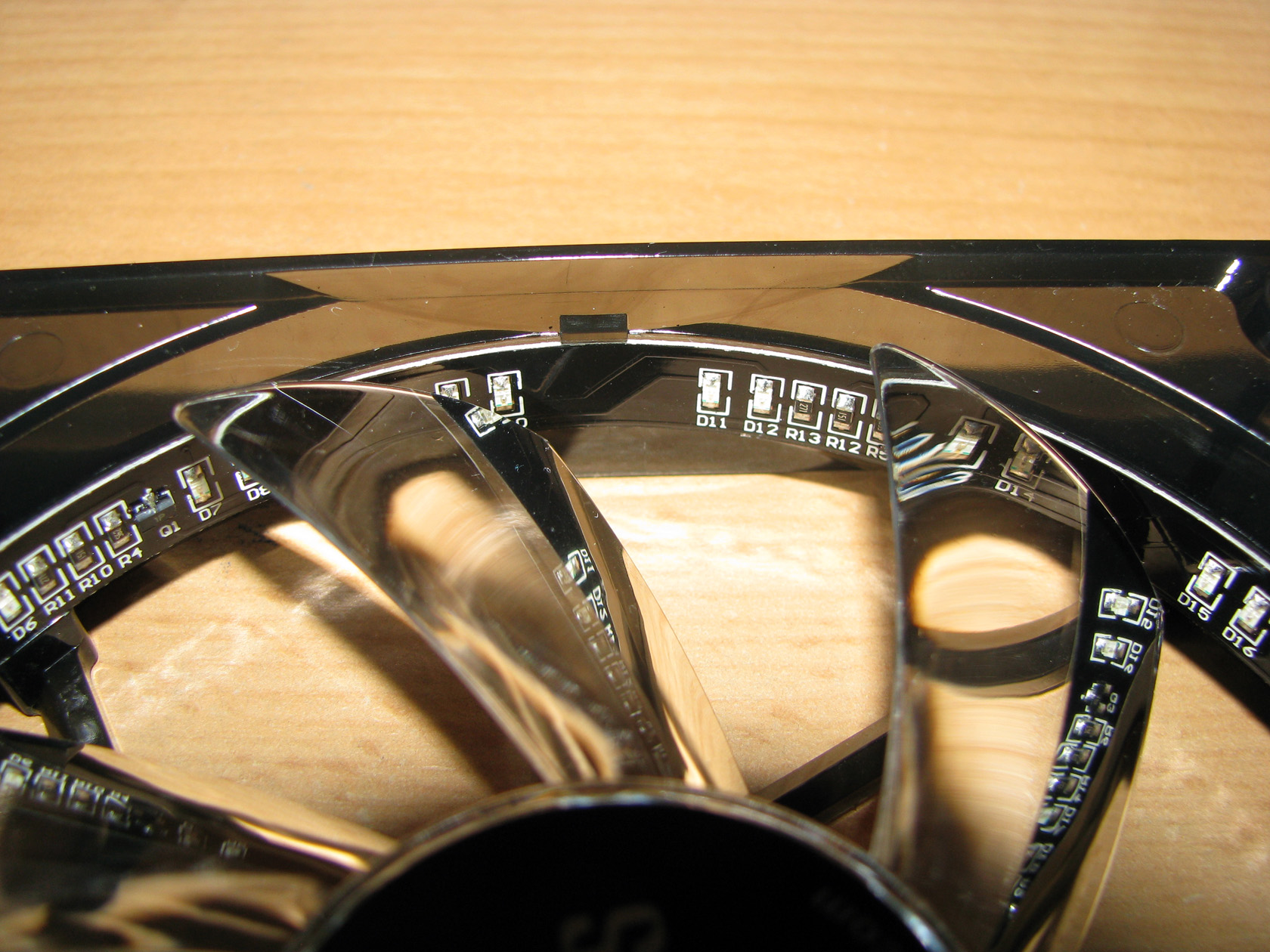
The fan is made of a semi-transparent 120x25mm black frame and a transparent propeller with 7 blades, where you can see the first interesting point of the fan. Half of each blade is transparent, while the other half has a reflective surface most probably to reflect the lights. My attention was also drawn by the fact that there is an LED stripe inside the frame with red and blue LEDs, and the frame itself is thinner in order not to reduce the size of the propeller. I mention this, because if you are holding the fan in your hand and you squeeze it a bit, then you hear a frightening noise and the propeller stops.
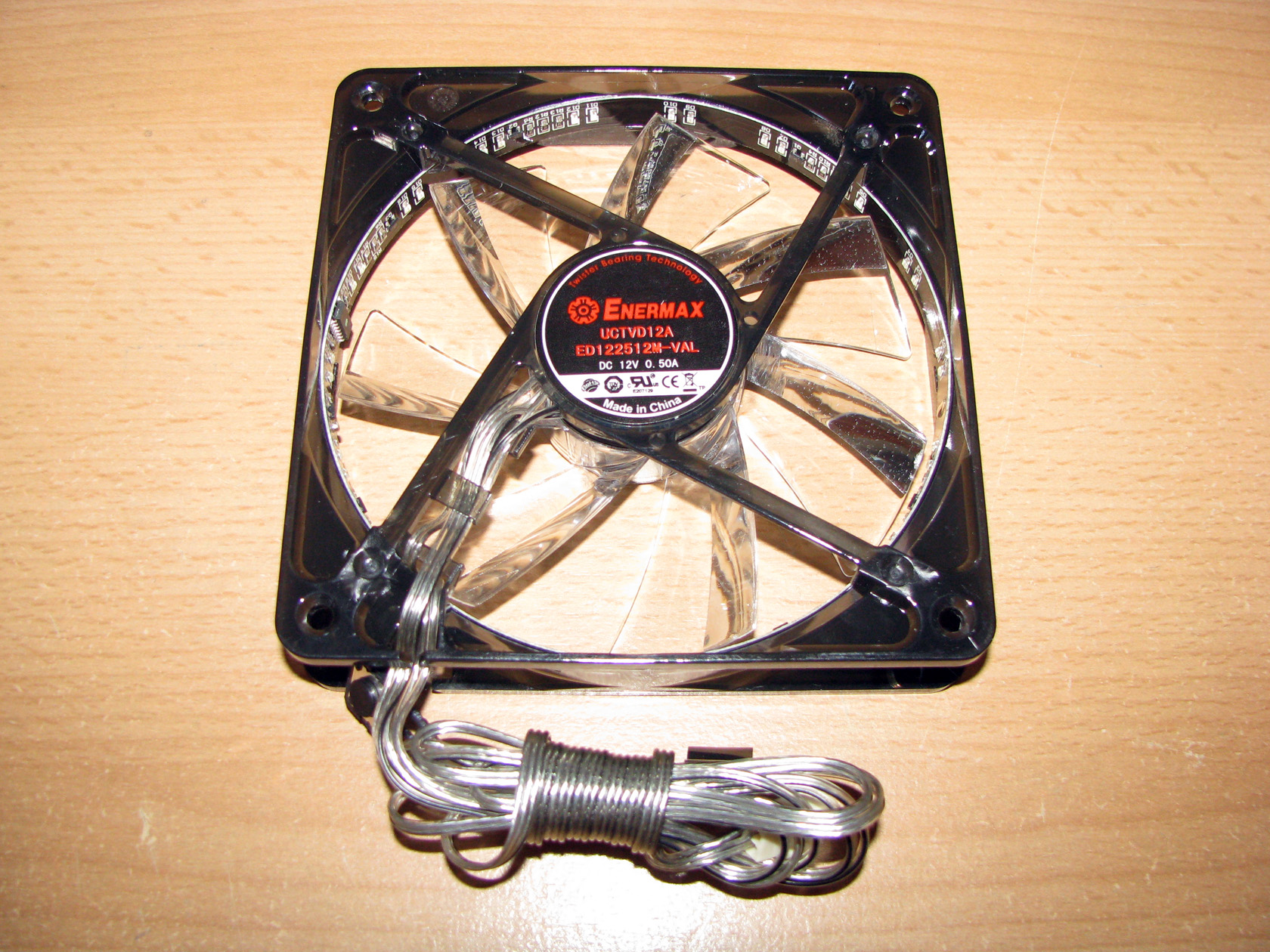
The next points of interest of the fan are the three relatively long cables coming out of it, namely:
- A 3-Pin power cable.
- A cable with potentiometer for rpm regulation.
- A cable with a button for switching between backlight modes.
The three cables are fixed to the fan and cannot be removed.

The standard Enermax T.B.Vegas Duo 120mm packaging includes:
- Four rubber screws
- 4-to-3 Pin power adaptor
- Two self-adhesive rubber strips for attaching the other two cables to the case.
The tests will be conducted in my standard way. I will mount the sample and test it at 5V/7V/9V/12V and my goal will be to check the authenticity of the technical characteristics given by the manufacturer. The product will be tested under close-to-perfect conditions, not taking into account any external factors. The results achieved during the test can in no way be the same if the fan is mounted on a cooler or on the case fan hole of any modern computer case. I will measure the amount of air going through the fan for one hour and its speed. For this I use a fan controller, a voltage meter, an anemometer and a stand made specifically for this purpose.

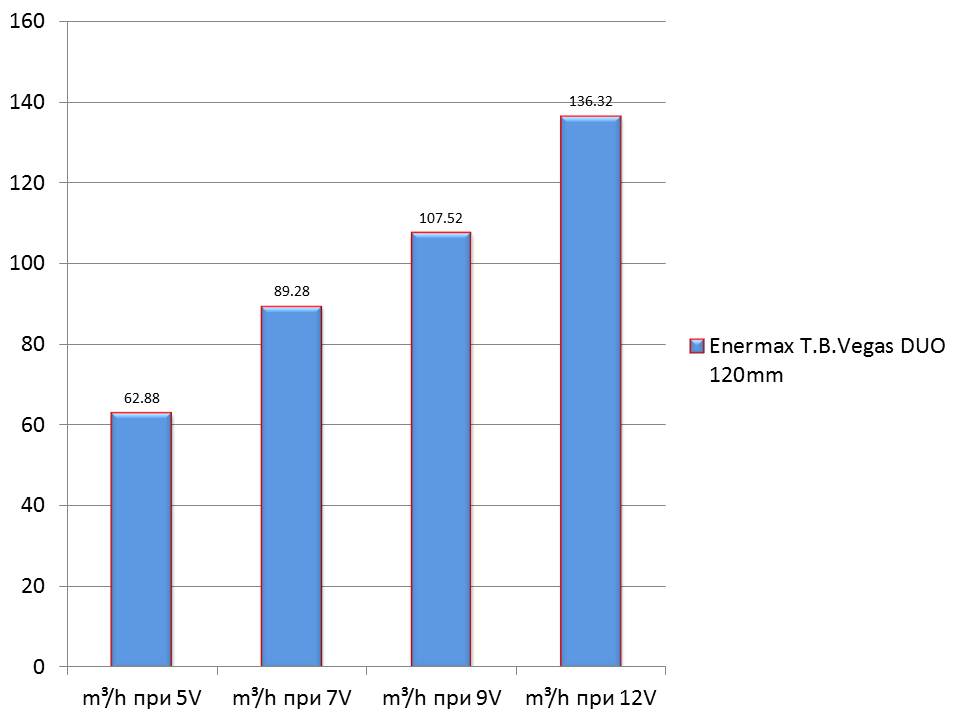
The test results are shown in the following charts:
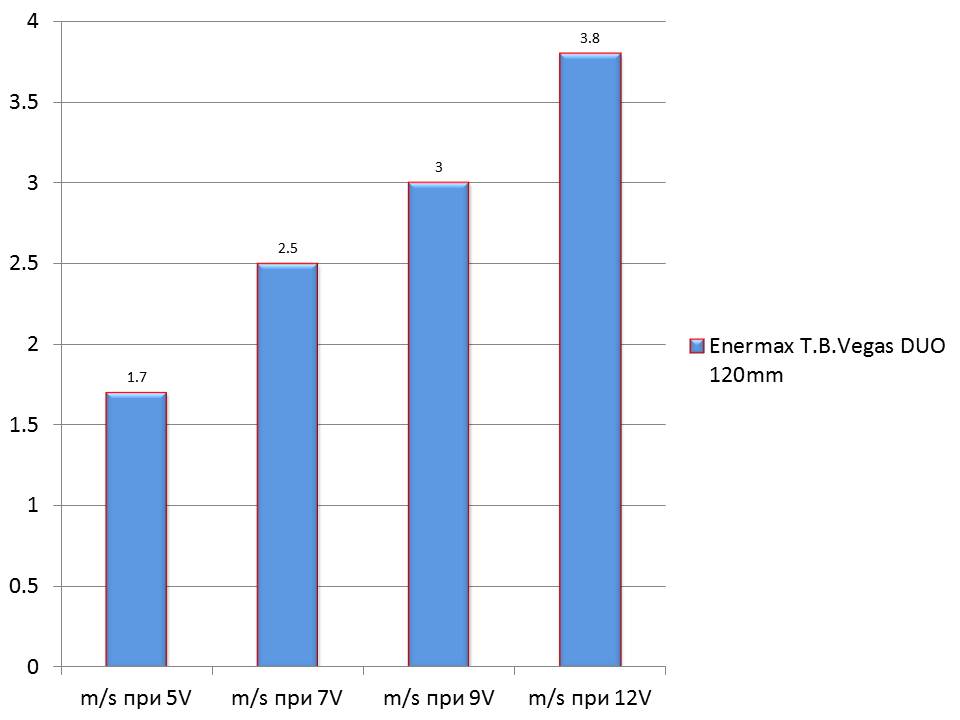
Airflow through the fan at 5V, 7V, 9V, 12V.
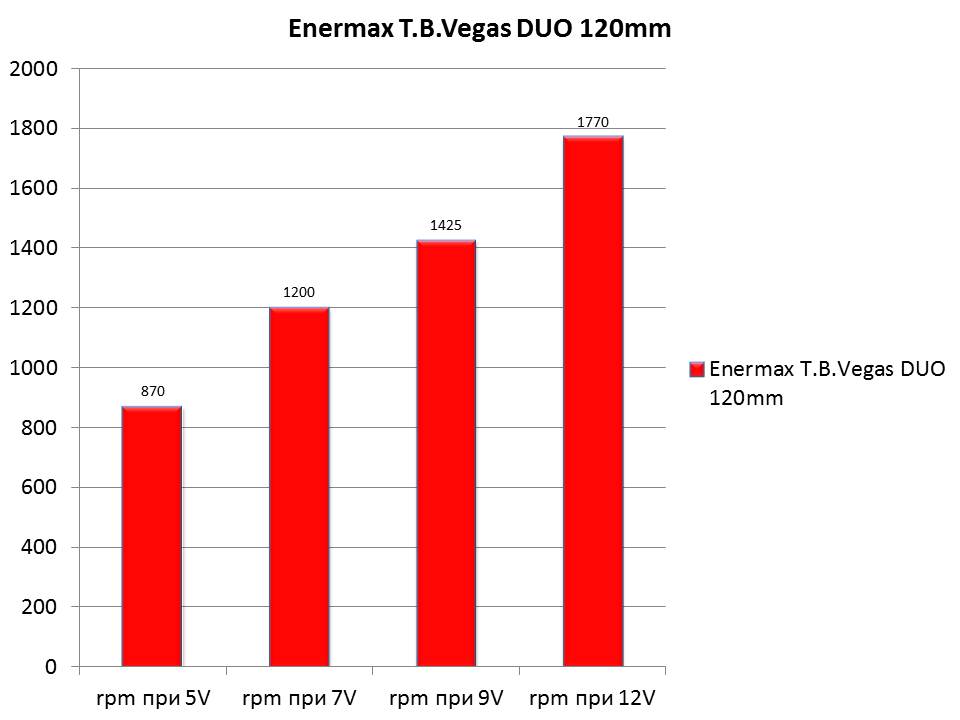
Propeller rpm during the tests at 5V, 7V, 9V, 12V.
The anemometer showed the following airflow levels:
After mounting the fan to the stand and leaving it to run for about 30 minutes at maximum speed, it was time for the tests to begin.
As with my other test, again I started with a gradual increase of the voltage through the Lamptron FCT starting at 0V and the Enermax T.B.Vegas DUO made one full revolution at 4,5V.
Test at 5V:
After leaving the fan to run at 5V for a while, I conducted the first test. The fan reached a speed of 870 rpm and airflow of 62.88 m² per hour. It remained completely noiseless. Also, I noticed that the blue backlight did not light up at all, while the red one lit up slightly.
Test at 7V:
The second test was conducted at 7V and the fan reached airflow of 89.28 m² per hour and a speed of 1200 rpm. At this speed I could slightly hear the sound of the wind going through the propeller. The red backlight lit up more noticeably and the blue one lit up as well, albeit slightly.
Test at 9V:
During the third test all LEDs lit up. The speed of the propeller was 1425 rpm and the airflow – 107.52 m² per hour. Here you could hear the noise of the fan quite clearly.
Test at 12V:
The last test at 12V made me stare at the incredible backlights for minutes. The fan was quite noisy but apart from the incredible appearance, it also offered airflow of 136.32 m² per hour and a speed of 1770 rpm.
After taking an in-depth look at the sample, it is time for me to express my personal opinion.
- Performance: On the whole, Enermax T.B.Vegas DUO is quite well-balanced and can be used both at 5V, be it without the backlight, yet completely noiseless, and at 12V with a serious airflow level.
- Noise levels: As I already said, the fan is very quiet at 5V and 7V with comparatively good airflow levels, while at 9V and 12V it is quite noisy but the airflow levels are considerable.
- Vision: The fan offers two different backlight colours – red and blue. Combined, there are 11 different work modes, creating a truly spectacular lights effect. Since I was amazed by the result and I had never seen such a model before, I decided to make a video of Enermax T.B.Vegas DUO and its different modes of backlight. You can see the video here:
I could point out the following disadvantages:
- Lack of PWM regulation, however there is a fixed rpm regulator.
- The thin frame of the fan, which needs to be handled carefully or otherwise it could be easily damaged.
I think that Enermax T.B.Vegas DUO deserves the following reward:

The model has been added to the 120mm fans catalogue.
I thank Enermax for the sample!


Харесва ми този вентилатор